





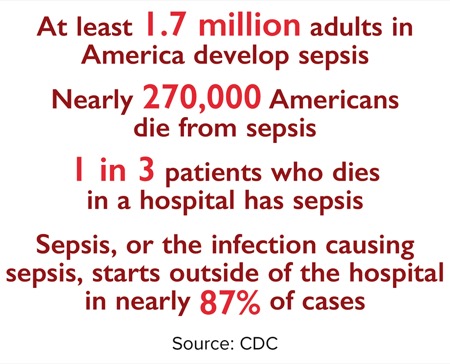
About 1.7 million U.S. adults develop sepsis each year and at least 350,000 die; nearly 87% of those patients have an infection that is not getting better, said CDC Director Mandy Cohen, MD, MPH.
The CDC recently released the Hospital Sepsis Program Core Elements to support U.S. hospitals in ensuring effective teams and resources to more quickly identify sepsis and improve survival rates. This resource is intended to help hospitals implement, monitor and optimize sepsis programs, the agency said.
“Survival and recovery depend on quick action on the part of family members and caregivers, as well as hospital staff,” Dr. Cohen said during a press briefing on the core elements.
“The care of sepsis is complex, and I will say that as a physician who has cared for those patients, it requires rapid coordination among multiple hospital departments and disciplines to respond and then manage the recovery of the patient,” she said.
The Sepsis Core Elements approach enables hospitals to structure their sepsis programs to coordinate multiple departments and disciplines and effectively manage the multifaceted care needed, according to Raymund Dantes, MD, MPH, CDC medical advisor and a co-developer of the core elements.

The core elements provide a guide for structuring sepsis programs that put healthcare providers in the best position to rapidly identify and provide effective care for all types of patients with sepsis, according to Dr. Dantes.
Modeled after the CDC’s Core Elements of Antibiotic Stewardship, which has proven to be a useful stewardship resource, the Sepsis Core Elements were created with the expectation that all hospitals, regardless of size and location, would benefit from this resource and incorporate the following elements into their sepsis programs:
- Leadership commitment that dedicates human, financial and information technology resources to be successful.
- Accountability: Appointing a leader responsible for program outcomes and setting concrete program goals.
- Multi-professional expertise: “It is critical to engage those key partners throughout the organization, such as emergency department; the intensive care units; wards; physicians and nurses; specialists; and those caring for distinct populations, such as pediatrics or labor and delivery,” Dr. Dantes said.
- Action: Implementing structures and processes to improve the identification of management of and recovery from sepsis.
- Tracking: Measuring sepsis epidemiology, outcomes, progress toward program goals and the effect of sepsis initiatives.
- Reporting: Providing usable information on sepsis treatment and outcomes to relevant partners.
- Education: Providing sepsis education to healthcare professionals during onboarding and annually.
“These recommendations complement clinical guidelines for early recognition and early management, and provide additional guidance for supporting patients recovering from sepsis,” Dr. Dantes said.
The CDC’s 2022 National Healthcare Safety Network Annual Survey of 5,221 hospitals found that 73% report having sepsis teams, but only 55% report that team leaders are given dedicated time to manage sepsis programs (MMWR Morb Mortal Wkly Rep 2023;72[34]:907-911).
“We know that all the evidence suggests early identification and early appropriate treatment with antibiotics saves lives,” said Chris DeRienzo, MD, the chief physician executive at the American Hospital Association, who also spoke at the briefing.
“That is an easy thing to say and really hard to do. Why? Because sepsis isn’t just one disease, and [in] my specialty population of sick and extremely premature newborns, the early warning signs of sepsis can look wildly different than those of trauma patients coming out of surgery or of elderly patients in a nursing home. That is why it is crucial to have leadership commitment to support the early identification and early treatment programs needed in hospitals.”
Because of the complexity of this disease, early signs can be masked.
“I think one of the challenges is that sepsis can look very different across different people and can also overlap with other types of conditions,” added Hallie Prescott, MD, MSc, from the University of Michigan, in Ann Arbor, a co-developer of the Hospital Sepsis Program Core Elements.
“[Sepsis] always needs to be at the forefront of everyone’s mind,” Dr. Prescott said. “It requires a holistic assessment of the patient’s clinical presentation, as well as [their testing results].”
The experts hope the Sepsis Core Elements will improve the odds for everyone who develops sepsis, they said.
“When patients have multiple health issues, it is essential to bring together experts from across the hospital in a multidisciplinary approach to build those programs targeted at early identification and treatment,” Dr. DeRienzo said. “Those programs look something like other code teams, and the best code teams that I’ve been a part of often function like a well-oiled NASCAR pit crew.”
He said patients and caregivers are an important part of that crew, and they need to be heard during a crisis.
Because hospitals throughout the country are so different in size, staffing and populations they serve, the Sepsis Core Elements could be adapted for different facilities.
“I think one aspect of the CDC’s Sepsis Core Elements that we really appreciate is they don’t put forward a one-size-fits-all approach,” Dr. DeRienzo said. “When I look across the spectrum of hospitals and communities in this country, the core elements allow our hospitals to build a program that fits their community.”
Dr. Cohen added, “We know that programs dedicated to the care of patients with sepsis have been successful in saving more lives, reducing the time patients need to stay in the hospital and cutting healthcare costs. The bottom line: The CDC believes that sepsis programs in every hospital—regardless of size, location and resources—can strengthen the quality of care delivered to these patients and ensure their survival.”
The sources reported no relevant financial disclosures.

This article is from the October 2023 print issue.