





Originally published by our sister publication General Surgery News
‘A virus is a piece of bad news wrapped up in a protein.’—Sir Peter Medawar, 2011

My first encounter with the power of a virus took place when I was 11 years old. I contracted a relatively mild case of polio with leg paralysis. After several weeks of vigorous walking, I was able to fully recover. At age 14, I spent the afternoon playing ball and the evening at the home of a close friend, who said he was feeling very tired. When I called the next morning, his father, in tears, told me that my friend had been hospitalized and had died during the night of bulbar polio. Had he lived, he would have been confined to an iron lung for weeks, months or perhaps a lifetime.
During some summers in my youth, movie houses and public swimming pools were ordered closed for the protection of children from polio. Years later when I was a surgeon, a single patient infected Dr. John Najarian, multiple staff and me with hepatitis B. After recovery, I found that runners, myself included, could no longer run as long or as hard. A British marathoner biopsied his own gastrocnemius muscle and found hepatitis B viral particles. Viruses persist.
Despite being fully vaccinated and boosted, this past June while attending a national surgery meeting, my wife and I contracted COVID-19 for the first time; members of my family have now had it twice. This virus continues to mutate.
Musing on the power of viruses to take lives, as well as to change them, I elected to understand them better.
Although viruses have killed more people throughout history than natural disasters and wars, most virologists do not consider viruses living organisms because they do not fit their definition of having the capacity to reproduce themselves. Viruses depend on host cells for their existence and replication. Several postulates exist as to their origin. Some maintain they are degenerate intracellular parasites or relics of pre-cellular life. Others assert they are cellular genes that have escaped the cell, a theory supported by the fact that there are DNA and RNA viruses. The one or two strands of the former consist of deoxyribonucleic acid, the latter of ribonucleic acid.
The prevalence of viruses is astounding. Their earthly number now exceeds that of all the grains of sand and stars in the universe. If these 10 nanomillion (1031) particles were laid end to end, they would stretch for 100 million light-years. Their variety is equally remarkable. There are about 140,000 different viral species in the human gut alone. And 800 million viruses fall to Earth per square meter daily from the sky. Their variance in size is considerable within the population of viruses, ranging from the adenovirus of about 20 nm, 2,000 times smaller than a grain of sand, to the Pandoravirus, 1,000 nm in length. The COVID-19 virus is 50 to 140 nm.
Fortunately, only about one in a billion viruses is a pathogen. When an animal, including the human animal, is infected with a pathogenic virus, the virus particle travels along the host’s cell surface until it finds a friendly receptor protein, with which the virus protein envelope fuses and releases its nucleoprotein into the cell. This mechanism may be augmented by phagocytosis of the entire virus by the host cell. One way or another, we, as human hosts, are complicit in becoming virally infected.
On entering the host cell, the virus subverts the cell’s protein synthesis mechanism to replicate itself, either by the lytic cycle or the lysogenic cycle of reproduction. In the lytic cycle, the virus destroys the host cell’s DNA and redirects the cell to make its own DNA that commands its own protein phage production. In the lysogenic cycle, the virus cohabits or fuses with the host’s DNA and, subsequent to cell division, takes over the new cell’s reproductive processes to make more of itself. DNA viruses replicate primarily in the nucleus of the host cell; RNA viruses bypass the nucleus and, for the most part, replicate in the host cell’s cytoplasm. The subsequent complex phage protein reproduction takes place in the cell’s ribosomes.
The body’s natural response to a virus-infected cell is complicated. The cell combats its internalized viral invader by producing interferons, which play a role in preventing viral replication, and act as signaling molecules to other body cells to come to the rescue. This response includes T cells, natural killer (NK) cells and cytokines, all of which attack the infected host cell and kill it, together with its viral parasite. Killing an invasion of hostile aliens by killing your own cell population that harbors them does not seem to be either an efficient or a highly sophisticated solution.
There is a better defense against invading pathogenic viruses, namely, intercepting them before they invade cells or, at least, minimizing their cellular penetration and replication. There are two means we know at present to achieve this goal: antivirals, the equivalent of bacterial antibiotics, given prophylactically or post-infection, and antibodies, synthesized as a response to a prior infection or by vaccination. Science has made greater progress in developing vaccines than in concocting antivirals.
A vaccine consists of an inoculation of a small portion of an infectious virus or, preferably, a noninfectious portion of a virus. This process is also dependent on the invaded body’s self-defense mechanism—in this case, the production of antibodies that hunt for specific surface proteins (antigens) of vaccinated-against pathogens. By bonding with specific antigens, the antibodies coat the invader virus receptor proteins, thereby preventing cellular penetration. Subsequently, viruses cannot survive this attack and the viral antibody coated complex is removed by circulating phagocytic macrophages.
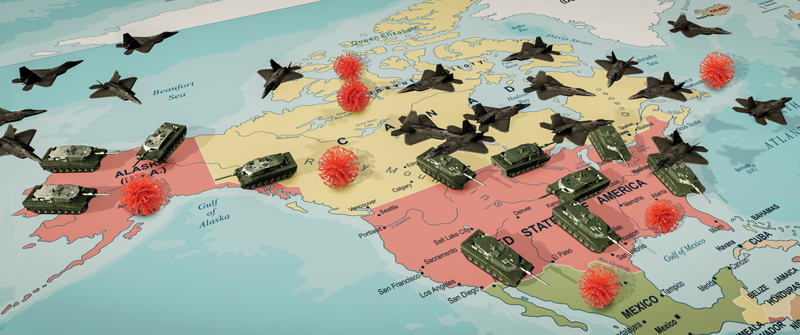
A pathogenic viral invasion of a human is an invasion by an alien enemy, initiating a war. The host’s body is the battlefield. The conduct of this war ranges from a border confrontation to a major military engagement with a global and at times fatal outcome for the victim. If victory ultimately goes to the host, the invading viruses “die” (cease to exist). If the viruses ultimately win, unless they can rapidly occupy another target organism, both the host and the contained viruses die. On the battlefield, circulating antibodies created by a previous invasion of the same virus, or by vaccination, and a rapid inflammatory response may leave the host unperturbed and even unaware of the viral incursion or, at most, mildly symptomatic. Major engagements of viral forces and host defenders will result in cellular destruction that makes the host ill, and, depending on age and prior conditions, very ill, necessitating hospitalization at times and the spectra of ultimate host surrender and death.
The current viral culprit responsible for the disease COVID-19 is the SARS-CoV-2 virus, a single-stranded RNA virus of the family Coronaviridae, characterized by surface spike proteins. It has the ability to mutate rapidly to immunologically diverse variants. These variants may not be recognized, or only partially recognized, as invaders by the host’s antibodies. The global response to the COVID-19 pandemic has been devastating. There have been 18 million documented and reported deaths from COVID-19 worldwide, with more than 1,100,000 deaths in the United States (about 350/100,000 people).
Recommendations from the CDC and National Institutes of Health over time have been contradictory and confusing about isolating, gathering in public places, school quarantining and masking. In March 2022, the CDC stated that masking for most situations was optional. As a result, most people stopped masking, and the COVID-19 infection rates started to rise. In addition, anti-vaxers and COVID-19 conspiracy theorists confused and swayed the minds of millions of our citizens. National and individual health recommendations regarding COVID-19 have been taken out of the realms of medicine and science and made political.
We are as yet ignorant about this virus’s versatility, its range of symptomatology and its ability to linger as long COVID. Obtaining this knowledge will help us to be prepared for future viral battles that history tells us will surely come. Indeed, the MPXV virus, or mpox virus, is at the world’s threshold. We can be passive and rely on natural “herd immunity,” hoping that the virus will run out of susceptible hosts. This hope, however, depends on minimal viral mutations and/or mutations to a less virulent or nonhuman invasive form of the disease. Such a sequence of events eventually ended the Spanish flu of 1918-1920, but not until as many as 100 million were killed. COVID-19 is unlikely to take this course because of the rapidity of its mutations and reinfections with a variant. Up to now, the mutated variants seem to be more infectious but less virulent. We should ask, however, what if the next mutation contains a jump in virulence? Reliance on nature and chance should not be the only approaches of a scientifically prepared nation.
Can we do better? To do so, we must increase our understanding of the COVID-19 virus in order to defeat it. What antiviral weapons can we develop? First of all, we must create vaccines that will induce universal antibodies against current and future variants by targeting the very essence of our viral foe, not only its protein subunits. We were able to do this with smallpox and polio. However, it is much harder to eliminate SARS-CoV-2 because of its ephemeral nature. We must be nimble and able to develop effective antivirals that keep pace with mutational virus resistance by rapidly synthesizing new agents. These drugs must be used therapeutically at the first stage of infection, or prophylactically, with the option of taking a daily pill. And, we can all practice good hygiene, as well as masking, quarantining and isolating when appropriate.
Above all, nations and individuals should recognize the need for a rational, uniform, universally accepted healthcare policy. There are few citizens who do not agree to maintaining and funding a strong military to protect our freedoms from hostile invaders. If our citizens were taught to understand the issue, they would agree that combating invasions of viral hostiles is just as vital a national priority. Our professional healthcare community, using the weapons of science and the scientific method of proof of concept, needs to assume leadership in this effort.
Viruses may outnumber the stars but …
‘It is not in the stars to hold our destiny but in ourselves.’—Cassius in “Julius Caesar,” by William Shakespeare
Dr. Buchwald is professor emeritus of surgery and biomedical engineering, and the Owen H. and Sarah Davidson Wangensteen Chair in Experimental Surgery, at the University of Minnesota, in Minneapolis. His articles appear every other month.