


By Ethan Covey
A new strategy called Test to Stay (TTS) allows unvaccinated children to remain in school even if they have been exposed to SARS-CoV-2.
“Over the past few months, the CDC has collaborated with school districts across the country to evaluate a new strategy called Test to Stay,” CDC Director Rochelle Walensky, MD, MPH, said during the Dec. 17 CDC COVID-19 Response Team briefing.
The protocol calls for increased testing of close contacts after a COVID-19 exposure rather than quarantining the entire class. Testing needs to be performed at least twice during a seven-day period after exposure, and if children meet certain criteria and continue to test negative, they can remain in school, she explained.
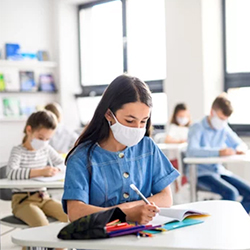
In two studies of the program, masks were worn correctly and consistently. Close contacts of a positive case were monitored for COVID-19 symptoms, and if they became ill, they stayed home; and children who did not develop symptoms were tested regularly.
During the fall of 2021, schools in Lake County, Ill., implemented a TTS strategy that was found to be very suc-cessful, allowing up to 8,152 in-person learning days that in 2020 would have been quarantined (MMWR Morb Mortal Wkly Rep2021;70[5152]:1778-1781).
Among 1,035 students and staff members who were enrolled in the TTS program, secondary transmission of COVID-19 was limited to 1.5% of cases, and no tertiary cases were identified.
“This study showed that implementation of the TTS strategy, along with other layered prevention measures limited further spread of COVID-19 within K-12 schools and allowed students and teachers who are not fully vaccinat-ed to continue in-person learning,” said Emily J. Holman, MSc, an epidemiologist with the CDC COVID-19 Re-sponse Team. “Schools may consider TTS as an option for keeping asymptomatic school-associated close contacts who are not fully vaccinated and do not test positive for SARS-CoV-2 in the classroom as an alternative to tradi-tional quarantine at home.”
In Los Angeles County student rates of COVID-19 did not increase in schools where TTS was implemented, and tertiary transmission did not occur. However, only one in five schools opted to participate in the program (MMWR Morb Mortal Wkly Rep 2021;70[5152]:1773-1777).
This highlights some of the difficulties associated with TTS, including costs and the need for additional resources.
“TTS is a resource-intensive strategy that may be difficult for schools to implement due to the robust contact identification and contact tracing effort required, increased administrative demands on staff, and the availability of COVID-19 testing,” Ms. Holman said. “High-resource schools might have more staffing and physical spacing to apply prevention strategies, that is, distancing students, which might result in lower spread of COVID-19 compared to lower-resource schools.”
Despite these challenges, TTS, when used in partnership with other mitigation efforts, may provide significant benefits to schools looking to maintain in-person learning while navigating the continued spread of COVID-19.
“TTS is another valuable tool in a layered prevention strategy that includes promoting vaccination of eligible students and staff, requiring everyone age 2 and older wear a mask inside schools and facilities, keeping at least 3 feet of distance between students, screening testing, ventilation, handwashing, and staying home when sick,” the CDC said.
In addition, the CDC recommends everyone aged 5 years and older get a COVID-19 vaccine to help protect against infection. Adolescents aged 16 years and older can receive a booster shot at least six months after a primary series. Widespread vaccination for COVID-19 is a critical tool to best protect everyone from COVID-19 and COVID-19–related complications.