

By Marie Rosenthal, MS
Is now a good time to reinstate in-person learning in the classroom? For the most part, yes, according to infectious disease and pediatric experts, but much of the decision depends on the community where the school is located and the ability of the school to apply good mitigation practices and pivot if cases occur in the school.
“Why is this an appropriate time for schools to be open for in-person learning?” asked Tina Q. Tan, MD, FIDSA, a professor of pediatrics at Northwestern University Feinberg School of Medicine and an infectious disease pediatrician at the Ann & Robert H. Lurie Children’s Hospital of Chicago.
“Now, we have much more data regarding how to safely reopen schools than we did six months ago, and this information can help us develop new steps in school reopening across the country,” she explained during an Infectious Diseases Society of America press briefing.
Preeti Malani, MD, MS, MSJ, FIDSA, FSHEA, the chief health officer and a professor of medicine in infectious diseases at the University of Michigan, in Ann Arbor, agreed with Tan that the data are there to safely reopen schools, but there are many factors that will dictate what that reopening will look like.
“Last spring, it really was switching off the lights, shutting the door and sending everyone home,” she said at the same briefing. “Getting back is much more incremental. I think we all are going to need to remember that it doesn’t need to be all or nothing.”
Classroom Safety
Some schools have instituted a hybrid model that combines in-person learning with virtual learning, and that might be the best approach for that particular community until the teachers, parents, children and staff are comfortable and confident back in the classroom, Malani said. There is a lot of anxiety, concern and misinformation about returning to in-person learning that will need to be overcome before everyone feels safe in a classroom.
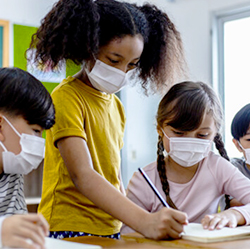
“If people don’t feel safe, it’s really difficult and it becomes challenging,” Malani said, adding that it was important to keep emphasizing the mitigation factors that work, which include masking, social distancing, hand hygiene and good ventilation or holding classes outdoors weather permitting.
A big problem in many districts is that they don’t have the resources to keep the schools safe. Even providing good ventilation can be a challenge for some resource-poor schools.
Although schools themselves do not appear to be associated with substantial transmission, it is important to ensure that protective mitigation protocols are in place, Tan agreed. “Over the last year, we have learned that when appropriate mitigation protocols are in place, the school environment itself does not seem to serve as a superspreading environment,” she said.
The CDC issued guidance that can help schools safely reinstitute in-person learning. One important change is the social distancing requirement; children can be 3 feet apart rather than 6, which was recommended in September.
A recent study led by Beth Israel Deaconess Medical Center showed that the physical distance among children can be safely lowered. In a retrospective, statewide cohort study, the researchers compared the rates of COVID-19 cases in students and staff in Massachusetts public schools among districts with universal mask mandates but different physical distancing requirements. The team found no substantial difference in the number of COVID-19 cases among either students or staff in school districts that implemented a distancing policy of 3 versus 6 feet among students (Clin Infect Dis 2021 Mar 10. https://doi.org/10.1093/cid/ciab230).
Several other papers have concurred that social distance can be lowered in schools, including a report that reviewed more than 185 studies in 16 countries (Lancet 2020;395[10242]:1973-1987). That analysis found reduced transmission occurred with physical distancing of at least 1 m (3.2 feet), which is the recommendation of the World Health Organization.
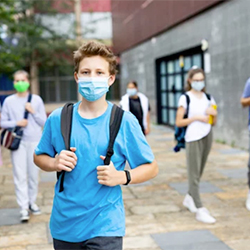
In addition, “they should be cohorting their students and their teachers into smaller groups, using outdoor spaces whenever possible and having protocols in place if someone becomes ill or tests positive for COVID-19,” Tan said.
Every school official must keep an eye on their communities. “The school should have the flexibility to go back to virtual learning if there is a surge of COVID-19 in the community, ” Tan said.
Teach the Teachers
It will be important to educate staff and families about symptomatic and asymptomatic transmission, as well as the importance of staying home when someone feels ill, reminded Lea S. Eiland, PharmD, BCPS, BCPPS, FASHP, FPPA, a clinical professor and the associate department head of the Department of Pharmacy Practice at Auburn University Harrison School of Pharmacy, in Auburn, Ala.
Although it has become the norm for many colleges and universities, many elementary and high schools are not equipped to test large numbers of students, so it might be more difficult for them to ensure that sick children are kept home.
“Testing in the K-through-12 setting is not quite as nimble as testing has been in the university setting,” Tan said. Many of the school districts do not have the financial resources to provide widespread testing for that age group. “The other thing that we’re learning is that because children, most of the time, are either asymptomatic or have very mild symptoms, testing really doesn’t add very much to whether or not a person is safe to go to school.”
Temperature monitoring and relying on teachers to help assess their students might be helpful in those schools, Eiland said. “Due to staff and resources, [temperature monitoring] may be all that teachers can do,” she said. “But teachers may be able to identify students who don’t feel well in the classroom.”
Everyone, staff and teachers, should be encouraged to “speak up” if they feel ill, Eiland added.
Better for Children and Parents
Few people dispute the importance of being in a classroom. “Classroom learning allows for hands-on learning experiences and interaction with other learners. While some active learning activities may be completed through remote learning, a greater depth and breadth of active learning exercises can be accomplished in person,” Eiland told Infectious Disease Special Edition.
“Social development occurs in a classroom and is not the same in remote learning. This social interaction can help students stay engaged in the learning process,” she said.
In addition, in-person learning is better for the teachers. “Seeing all students in the classroom and their facial expressions can help the teacher see students’ understanding or confusion through body language and tone.
This isn’t easy to see in remote teaching, and you may not see all students in your class on one screen remotely,” Eiland said.
Tan agrees, calling schools “fundamental to the well-being of children and adolescents.” In addition to academic instruction, they help in the development of social and emotional skills and provide physical, occupational and speech therapy, as well as mental health services. They are also a source of nutrition for many children in this country.
“The negative impacts that have resulted from not attending school in person are significant,” Tan said. “They include a major increase in mental health issues, especially in the adolescent population. We’ve seen falling standardized test scores, a decrease in academic progress and an increase of absent students or students who have dropped out of school all together.”
Parents also are suffering. A recent report found caregivers of children receiving virtual classroom instruction reported higher loss of work, decreased job stability, challenges in finding suitable child care, emotional stress and difficulty sleeping (MMWR Morb Mortal Wkly Rep 2021;70[11]:369-376).
In addition to better understanding how SARS-CoV-2 is transmitted and what factors prevent its spread, the availability of vaccines is another reason why now is the time to begin returning to the classroom. As of March 23, 25.3% of the U.S. population has received at least one COVID-19 vaccine, and 13.7% are fully vaccinated. Experts have estimated that in order for the United States to reach the herd immunity threshold, however, at least 70% of the population must be immune against COVID-19 to stop the spread of the disease.
“Everyone who wants the vaccine should be vaccinated,” Eiland said. “We, as health care professionals, can encourage all patients who are eligible to receive the vaccine by educating them about the clinical trial outcomes and explaining the vaccines’ efficacy in the prevention of disease and death from COVID-19.”
Many states have deemed teachers essential workers who should be vaccinated, and many are getting the vaccine. Increased vaccination will reduce potential transmission in the community, so it is an important component to getting children back in the classroom, but vaccine hesitancy is always a concern.
Malani said she is seeing a lot of acceptance of the vaccine at the University of Michigan, but there are pockets of the country that oppose vaccination. People need to understand that “vaccination protects individuals, but ultimately, it protects your whole community,” she said.
“In pediatrics, we deal with vaccine hesitancy and anti-vaccine sentiments on a daily basis,” Tan said, adding that vaccine messaging must be clear, correct and “targeted to the specific population that we are trying to reach.”
Considerations for in-class learning differ from grade to grade and community to community, reminded Malani, and the most important consideration is how to get back to the classroom in a way that is safe for everyone.
“We have learned to do this with a layered approach, protecting students, teachers and staff,” she said. “Mask wearing, being outdoors, making sure that there’s good ventilation, and now with vaccination—that really adds another important layer.”
The process of returning to in-person learning is a complicated emotional issue, but it can be done, they said. “Education is essential, and there are ways to get there safely and to move forward,” Malani said. “I think everybody’s going to need to be flexible and to be able to pivot and adapt.”