





Related Content

A newly published CDC report adds to growing evidence that COVID-19 vaccination continues to protect children and adolescents from clinically significant illness, particularly emergency department visits and hospital-level disease, even as vaccine effectiveness against infection changes over time (MMWR Morb Mortal Wkly Rep 2025;74[40]:607-614).
The study examined COVID-19–associated emergency department and urgent care visits among children six months to 17 years of age, using data from the CDC-funded Virtual SARS-CoV-2, Influenza, and Other respiratory viruses Network (VISION), a multisite electronic health record–based network in nine states.
The investigators found that updated COVID-19 vaccines were associated with meaningful reductions in medically attended illness, reinforcing the role of vaccination in limiting disease severity. During the period of Aug. 29, 2024, to Sept. 2, 2025, the effectiveness of the 2024-2025 COVID-19 vaccination was estimated to be 76% against COVID-19–associated emergency department or urgent care visits among immunocompetent children nine months to four years of age and an estimated 56% among children and adolescents five to 17 years of age, when compared with those who did not receive a 2024-2025 vaccine.
“This study adds to the understanding of vaccination by highlighting that COVID-19 vaccines help reduce the severity of illness,” said Gabe Alvarado, a CDC spokesperson. “While vaccine effectiveness can change over time, studies like this show that updated vaccines provide added protection for those who received them.”
Adding to the Literature
Although children generally experience milder COVID-19 illness than adults, pediatric infections can still lead to serious outcomes, including hospitalization and intensive care unit admission.
![18260218 COVID-19-vaccine-pediatric-benefits 483054780-[Converted]](/aimages/2026/IDSE0226_041a_8076__18260218_COVID-19-vaccine-pediatric-benefits_483054780-[Converted]_800.webp)
“This report confirms the effectiveness of COVID vaccination in children,” said Peter Hotez, MD, PhD, a professor of pediatrics and molecular virology and microbiology at Baylor College of Medicine, in Houston. “This is true not only because it prevents hospitalization and childhood deaths, but there is newer information that vaccination can prevent pediatric long COVID [JAMA Netw Open 2025;8(2):e2459672].”
Dr. Hotez added that pediatric vaccination remains a critical public health priority.
“The pediatric community needs to continue advocating for COVID vaccination of children and adolescents,” he said.
Paul Offit, MD, the director of the Vaccine Education Center at Children’s Hospital of Philadelphia, said the findings confirm long-established principles of vaccine immunology.
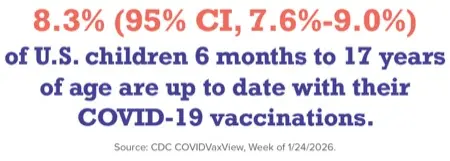
“When you see that you get very good protection against mild to moderate disease, you can assume you also have excellent protection against severe disease,” Dr. Offit said.
Dr. Offit noted that early clinical trials of mRNA vaccines demonstrated high levels of protection against mild, moderate, and severe disease shortly after vaccination. Although antibody levels decline over time—reducing protection against infection—vaccination continues to protect against hospitalization and death.
“We have study after study that has shown the same thing, that these mRNA vaccines are very good at inducing antibodies directed against the virus,” Dr. Offit said. “Those antibodies don’t allow the virus to attach to cells. Therefore, those viruses can’t infect cells.”
“The vaccine works, it’s safe, and if a child has never been vaccinated or never been naturally infected, they should get this vaccine,” Dr. Offit said.
The sources reported no relevant financial disclosures.
This article is from the February 2026 print issue.