

By Ethan Covey
Getting a COVID-19 vaccine during early pregnancy does not result in any increase in rates of major structural birth defects, according to a large claims-based cohort study.
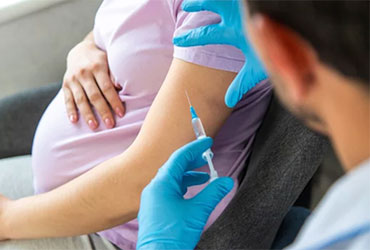
Researchers said the findings of the study support the safety of COVID-19 vaccination during early pregnancy (Pediatrics 2025;155[4]:e2024069778).
“While pregnant people were excluded from early randomized controlled trials for COVID vaccines, observational studies have shown that COVID-19 vaccination during pregnancy is safe,” said first author Stacey L. Rowe, PhD, MPH, a postdoctoral fellow in the Department of Nursing and Health Professions at the University of San Francisco.
“Recent studies have demonstrated that there is no positive association between COVID-19 vaccines administered during pregnancy and the occurrence of a range of birth defects,” Dr. Rowe added. “However, there is limited data on vaccine exposures given early in pregnancy, and pharmacovigilance monitoring can be challenged by the rarity of some of these defects; thus, ongoing monitoring is required.”
No Associations Found
The study analyzed data from Merative MarketScan Commercial and Multi-State Medicaid databases consisting of pregnancies ending in a live birth among people with an estimated last menstrual period between Aug. 15 and Dec. 24, 2021.
Among a total of 78,052 pregnancies, 1,248 major structural birth defects were identified. Of these, 1,049 (160.6 per 10, 000 live births) were in unvaccinated individuals, and 199 (156.4 per 10 ,000 live births) were among those who had received COVID-19 vaccinations. There were no differences in the prevalence of 18 major structural birth defects in people who did or did not receive a COVID-19 vaccine during pregnancy.
The study also did not find any association between the prevalence of birth defects and these variables: insurance type (public vs. private), SARS-CoV-2 infection during pregnancy before vaccination and the administration of other maternal vaccines (e.g., influenza and pertussis). A comparison of head-to-head prevalence of major structural birth defects by an mRNA vaccine platform and brand found no observed difference in rates of birth defects.
National Data Capture Diversity
Dr. Rowe noted that the study had limitations, including the potential for misclassification bias, live birth bias and residual confounding.
“Prospective standardized screening and medical chart review would have afforded the most complete form of ascertainment for these outcomes and exposures,” Dr. Rowe said. “However, this was not possible due to our retrospective study design and our use of medical claims data.
“A key strength of this study was our use of national data, capturing a diverse population across the U.S., including Medicaid enrollees,” she added. “We also had a large cohort, enabling us to examine several rare birth defects.”
Strengthening Provider–Patient Communication
Even with those limitations, the study had strong positive findings, according to the researchers.
“Our study reaffirms the safety of COVID-19 vaccines in early pregnancy,” Dr. Rowe said. “This is important because vaccine coverage during pregnancy remains low, [and] vaccine hesitancy is still a concern.
“Because provider recommendations are the most important predictor of a person’s decision to vaccinate, our findings can strengthen provider-to-patient discussions relating to vaccine safety, particularly for those who are hesitant about getting vaccinated in the first trimester, when other maternal vaccines are being given, or among those with a recent history of SARS-CoV-2 infection during pregnancy.”
Dr. Rowe reported no relevant financial disclosures.