

By IDSE News Staff
The half-life of an investigational next-generation monoclonal antibody (mAb) candidate, VYD2311, which is being designed to prevent and treat COVID-19, appears to be six months or longer, according to recent small studies by the developer, Invivyd.
The phase 1/2 study of VYD2311 was a randomized, double-blind, first-in-human clinical trial evaluating the safety and clinical pharmacokinetic profile of VYD2311 in 40 people across multiple routes of administration (ROAs) and dose levels for a single dose, and includes VYD2311 via IV, intramuscular (IM) and subcutaneous doses in four cohorts of 10 participants each, randomized 8:2 to receive drug or placebo. This range of ROAs and doses was tested to provide maximum flexibility in designing registrational pathways for both COVID-19 prophylaxis and treatment, while retaining a high barrier to resistance in the form of doses expected to accommodate significant evolutionary changes in SARS-CoV-2 viruses, the company explained in a release.
VYD2311 was well tolerated with all adverse events considered mild to moderate. All adverse events were deemed unrelated to study drug, or as expected and largely related to injection site reactions, headache, dizziness and infusion-related reactions, one of which required an infusion interruption and was later restarted without any further reaction.
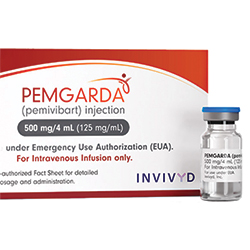
A formal estimate of in vivo half-life based on full phase 1/2 clinical trial data confirmed the long half-life of VYD2311. At six months (end of study follow-up), serum concentrations of VYD2311 remained high and were observed to be substantially greater than that of pemivibart (Pemgarda), Invivyd’s first-generation mAb. Specifically, half-life estimates by cohort ranged from 61 days (IV high-dose administration) to 76 days (via IM delivery) compared with pemivibart’s estimated half-life of 49 days.
VYD2311’s long half-life could allow long-term protection from symptomatic disease, potentially over multiple quarters, the company said.
In addition to assessing safety and tolerability of VYD2311 across the various ROAs, a comprehensive dose modeling analysis was conducted to support development discussions with the FDA about dosing for VYD2311 and follow-on COVID-19 mAbs. A Cox model analysis was employed using data from Invivyd’s recent CANOPY phase 3 clinical trial for pemivibart, incorporating both serum virus neutralizing antibody (sVNA) titers and long-term clinical efficacy data to provide a foundation for reevaluating titer thresholds used to define efficacy for immunobridging purposes for both immunocompetent and immunocompromised (IC) individuals.
The VYD2311 dose modeling strategy contemplated a range of IV doses for up to 4,500 mg, IM doses for up to 1,000 mg and subcutaneous doses for up to 750 mg. The results of this most recent analysis align well with prior published estimates of relationships between sVNA titers and observed clinical efficacy across multiple COVID-19 mAbs. Key findings of Invivyd’s updated dose modeling analysis include:
All dosing routes and doses assessed yielded modeled efficacy rates that showed IM and subcutaneous dosing every three months reflected robust efficacy for both IC and non-IC individuals, and such routes could simplify and scale administration, improving convenience.
- Modeling data indicate that IM administration can offer efficacy comparable to high-dose IV dosing. Critically, the IM route could eliminate the need for IV infrastructure—enhancing tolerability, accessibility and convenience.
- Antiviral titers conferred by VYD2311 to treat active infection are expected to substantially exceed the titers conferred by pemivibart and provide longer suppression of virus compared with pemivibart.
- VYD2311 builds on the first-generation mAb, pemivibart, which received emergency use authorization for the pre-exposure prophylaxis of COVID-19 in certain adults and adolescents (≥12 years of age weighing ≥40 kg) who are moderately to severely IC.
VYD2311 is 99%+ structurally identical to predicate antibodies adintrevimab and pemivibart, and represents the result of a technologically enabled, directed change in antibody sequence and spike protein target engagement uniquely accessible via Invivyd’s technology platform. These subtle but critical molecular changes for VYD2311 confer an increase in in vitro potency and a differentiated resistance profile compared with pemivibart, with corresponding potential improvements in clinical profile and accessibility, if approved. VYD2311 is now the third mAb from Invivyd to undergo randomized clinical trial evaluation while retaining a near-identical molecular structure and target binding site on the SARS-CoV-2 spike protein, a feature of Invivyd’s platform designed to provide vulnerable populations, healthcare professionals and regulatory authorities with a steady stream of high-assurance, minimally altered mAbs sufficient to navigate natural SARS-CoV-2 evolution rapidly with a non-vaccine approach.
“These data reinforce our confidence in VYD2311’s potential to offer a highly effective, scalable, convenient, and accessible solution for COVID-19 prevention,” said Mark Wingertzahn, PhD, the senior vice president of Clinical Development at Invivyd. “The safety profile, long half-life, and novel dosing strategies explored with VYD2311 not only build upon the well-established science for COVID-19 mAbs to achieve robust modeled efficacy targets but also align with our mission to provide non-vaccine mediated protection to those most at risk, including immunocompromised individuals, in a manner that integrates seamlessly into standard healthcare settings.”
Invivyd plans to discuss approval pathways for VYD2311 and follow-on COVID-19 mAbs with the FDA early in the third quarter of 2025, and expects to announce additional information about the VYD2311 program throughout 2025.