By Lisa Marshall
People who think they have COVID-19 should wait two days after respiratory symptoms develop before they test, but those who might have influenza or respiratory syncytial virus (RSV) would be better off testing right away, according to a new study from researchers at the University of Colorado at Boulder (Sci Adv 2024;10(24) doi:10.1126/sciadv.adk5108).
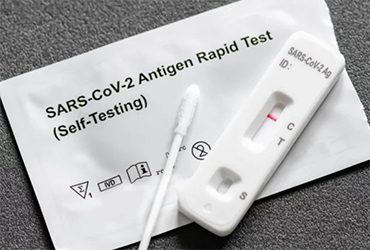
“For COVID, we found that if you only have one test, it's best to wait two days after symptoms arise to use it, because the virus is unlikely to be detectable until then,” said first author Casey Middleton, a doctoral student in the Department of Computer Science and the IQ Bio program. “For flu and RSV, you're best off to take that rapid test when you first feel symptoms.”
Ms. Middleton and senior author Daniel Larremore, PhD, a professor of computer science at the BioFrontiers Institute, developed the model to address several challenges that have emerged with the post-pandemic proliferation of rapid tests.
In recent years, companies have rolled out all-in-one tests that check for SARS-CoV-2, influenza A and B, and RSV simultaneously, and some doctor's offices and pharmacies offer a combination while-you-wait option.
Meanwhile, at-home COVID testing has become the norm for people to protect friends and family.
“If you're trying to make a decision about whether to go to Book Club or go to bingo night with the grandparents, testing is a really good idea,” said Dr. Larremore, whose lab combines computer science, math, epidemiology and biology to address public health challenges. “But COVID has changed. Each variant behaves differently and that means the way that they interact with tests may be different.”
When he and Middleton plugged information about omicron variants, patient behavior and other factors into their new computational model, it revealed that if a person with COVID tests immediately with a rapid test when symptoms emerge, they receive a false-negative result as much as 92% of the time. Waiting two days after symptoms brings that rate down to 70%. For people who can afford to take a second test on day 3, the false-negative rate drops lower, with the tests catching about one-third of infections.
That's because, with most people already previously exposed, their immune systems are primed to react upon encountering the COVID virus again, and that immune response itself causes symptoms. In addition, new variants in those with some immunity grow slightly more slowly than the original strain.
“Our symptoms are happening sooner, but it takes longer to reach enough virus in your body for it to be detectable,” Ms. Middleton said.
In contrast, with RSV and flu, the virus multiplies so quickly that once symptoms set in, there's already enough to make a test result show as positive.
“This is the conundrum,” Dr. Larremore said. “If you go in right away and test for all three, you can learn a lot from the flu and RSV tests, but you may have swung too early for COVID. If you wait a few days, the timing might be right to catch COVID, but you are too late for flu and RSV.”
While a 66% false-negative rate may seem high for a COVID test, Dr. Larremore noted that the tests are designed to identify people who have a high viral load and therefore are most likely to infect others.
“Diagnosing only one-third of infections can still cut transmission substantially if we've diagnosed the most infectious third,” he said.
Assuming that enough at-home tests are available, their study also suggests that a test to exit strategy—in which people test again before determining whether to return to work and socialize—can prevent more COVID infections with less inconvenience than the five-day isolation policy that was standard CDC advice until March.
This story originally appeared on the University of Colorado at Boulder website. It has been edited for style and length.