By IDSE News Staff
The FDA revised the emergency use authorization for the monoclonal antibody pemivibart (Pemgarda, Invivyd) to limit its use if 90% or more of SARS CoV-2 variants are not susceptible to the drug.
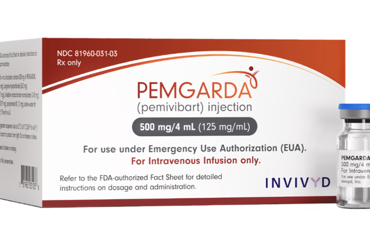
At the moment, pemivibart remains authorized for pre-exposure prevention of COVID-19, but the agency said it was proactively incorporating this Limitations of Authorized Use if variants with substantially reduced susceptibility to pemivibart reach the 90% threshold.
Pemivibart is a SARS-CoV-2 spike protein–directed attachment inhibitor authorized for the pre-exposure prophylaxis of COVID-19 in adults and adolescents. However, it is not meant to replace vaccination, according to the FDA.
The FDA also added important information to the authorized fact sheets to inform healthcare professionals and people receiving pemivibart of the increased risk for developing COVID-19 when exposed to variants of SARS-CoV-2 that have substantially reduced susceptibility to pemivibart. Detailed neutralization data can be found in the revised authorized?Fact Sheet for Healthcare Providers. Healthcare providers should inform patients of this risk and advise those who develop signs or symptoms of COVID-19 to test for SARS-CoV-2 infection and promptly seek medical attention, including starting treatment for COVID-19, as appropriate, if they test positive.
The most frequently reported SARS-CoV-2 viral variants circulating at this time in the United States are KP.3 and KP.3.1.1. Based on the CDC Nowcast estimates from Aug. 17, 2024, KP.3 comprises approximately 17% of circulating variants in the United States and KP.3.1.1 approximately 37% of circulating variants. Based on the data currently available, pemivibart is likely to retain adequate neutralization activity against KP.3. Preliminary, non–peer-reviewed data in the public domain indicate that KP.3.1.1 may have substantially reduced susceptibility to the monoclonal antibody.
Several treatments—nirmatrelvir+ritonavir (Paxlovid, Pfizer), remdesivir (Veklury, Gilead) and molnupiravir (Lagevrio, Merck)— are expected to work against currently circulating variants, and which are approved or authorized to treat certain patients with mild to moderate COVID-19 who are at high risk for progression to severe disease, including hospitalization or death. Healthcare providers should assess whether these treatments are right for their patients.
More information and resources about pemivibart are available on the FDA’s website.