





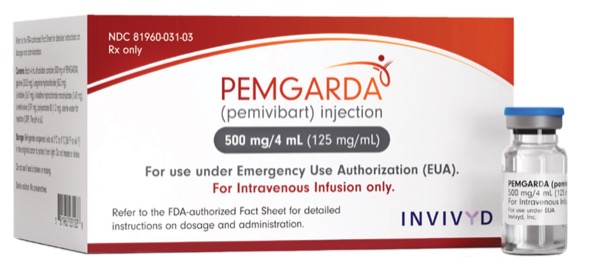
The Infectious Diseases Society of America (IDSA) updated its COVID-19 treatment guidelines to include the monoclonal antibody (mAb) pemivibart (Pemgarda, Invivyd), the only FDA-authorized pre-exposure prophylaxis for COVID-19, which was granted emergency use authorization (EUA) in March for people who are immunocompromised (Clin Infect Dis 2024;78[7]:e250-e349) because they are at a greater risk for hospitalization, mechanical ventilation or death from COVID-19.
The guideline panel suggested that pemivibart, a SARS-CoV-2 spike protein–directed attachment inhibitor, be given to patients 12 years of age and older who are moderately to severely immunocompromised when dominant COVID-19 variants in the patient’s region are susceptible to the agent.
“Healthcare professionals need every tool available to protect their most vulnerable patients from the very real risks COVID-19 continues to pose,” said Adarsh Bhimraj, MD, FIDSA, the director of Infectious Diseases Education and Fellowship at Houston Methodist Hospital, and lead author of the guidelines. “IDSA’s guideline update will help clinicians make the right decisions for their patients’ health and well-being.”
The panel acknowledged that the effectiveness of pemivibart may change as new variants emerge. At the moment, pemivibart remains authorized for pre-exposure prevention of COVID-19, but the FDA revised the EUA to limit its use if 90% or more of SARS CoV-2 variants become unsusceptible. The FDA also added information to the fact sheets about the increased risk for developing COVID-19 when exposed to variants of SARS-CoV-2 with substantially reduced susceptibility to pemivibart. The variants circulating in the United States are KP.3 and KP.3.1.1. Based on the CDC Nowcast estimates from Sept. 17, KP.3.1.1 makes up almost 53% of circulating variants, and KP.2.3 makes up about 12%. Pemivibart is likely to retain adequate neutralization activity against KP.3.
The treatments, nirmatrelvir+ritonavir (Paxlovid, Pfizer), remdesivir (Veklury, Gilead) and molnupiravir (Lagevrio, Merck), also are expected to work against circulating variants.
None of these are meant to replace vaccination, according to the FDA.
Invivyd said it had a robust supply of pemivibart and is working to ensure access. Pemivibart is covered by Medicaid and Medicare and the company is negotiating with other third-party payors. The Invivyd Patient Savings Program (PSP), a financial assistance program for eligible commercially insured patients, may cover up to $250 per dose of pemivibart and up to $1,000 per year for deductible and costs related to pemivibart.
In September, Invivyd announced continued neutralizing activity of pemivibart against the variants KP.3.1.1 and LB.1.
Invivyd recently announced dosing of the first participants in a first-in-human clinical trial for VYD2311, a next-generation mAb candidate for COVID-19 with high in vitro neutralization potency against post-omicron COVID-19 variants has potentially favorable biophysical properties.
VYD2311 was engineered from adintrevimab, Invivyd’s investigational mAb that has a robust safety data package and demonstrated clinically meaningful results in global phase 3 clinical trials for both the prevention and treatment of COVID-19. The pharmacokinetic profile of VYD2311 may offer the ability to deliver clinically meaningful titer levels through more patient-friendly means such as an intramuscular route of administration, the company said in a statement.
More information about pemivibart is available at bit.ly/4eCYY6C-IDSE.
Dr. Bhimraj reported no relevant financial disclosures.


This article is from the October 2024 print issue.