By IDSE News Staff
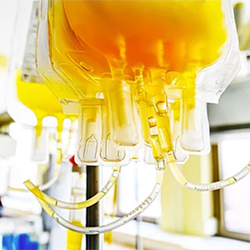
Patients with COVID-19 are less likely to develop long COVID if they receive early treatment with convalescent plasma containing antibodies against SARS-CoV-2 (mBio 2023;14[5]:e0061823).

The new research from a nationwide, multicenter study led by Johns Hopkins Medicine and the Johns Hopkins Bloomberg School of Public Health is a follow-up to a 2021 clinical trial that showed convalescent plasma was an effective and safe option as an early outpatient treatment for COVID-19 (medRxiv 2021 Dec 21. doi:10.1101/2021.12.10.21267485).
The original outpatient early treatment clinical trial was conducted between June 2020 and October 2021. The researchers provided 1,181 randomized participants with one unit each of either polyclonal high-titer convalescent plasma specific to SARS-CoV-2 or placebo control plasma. The participants were 18 years of age and older, and had tested positive for SARS-CoV-2 within eight days of the transfusion. A successful outcome was defined as not requiring hospitalization within 28 days after plasma transfusion.
Within 28 days of their transfusion, 17 participants out of 592 (2.9%) who received convalescent plasma and 37 out of 589 (6.3%) who received placebo control plasma required hospitalization within 28 days of their transfusion. This finding translated to a relative risk reduction for hospitalization of 54%.
As part of the clinical trial, the levels of 21 cytokines and chemokines were evaluated from 882 participants at screening, and at 14 and 90 days after they received either convalescent plasma or placebo.
For the latest study, the researchers used the cytokine and chemokine measurements, along with reports by patients of any post-COVID conditions at the 90-day examination, to determine whether there was any association between early convalescent plasma therapy and long-COVID symptoms. Statistical analyses were conducted to validate the findings, after adjusting for other factors that could make someone more prone to post-COVID conditions, such as demographics, comorbidities and vaccine status.
At 90 days after receiving either convalescent or control plasma, 590 (66.9%) of the study participants had no post-COVID conditions, while 292 (33.1%) did. Of the latter group, the most commonly reported symptoms were fatigue and anosmia.
They found high levels of cytokines and chemokines at screening for most of the study participants, which decreased more by day 90 in the convalescent plasma group.
Study participants who had higher-than-normal levels of interleukin-6 (IL-6) at screening were more likely to be among those with post-COVID symptoms by day 90.
“While cytokine levels decreased throughout the study population from infection to day 90, they dropped more significantly in those who received convalescent plasma early in the course of their illness. So, it appears that when IL-6 levels remain elevated during the COVID-19 recovery phase, it likely contributes to post-COVID conditions,” said study co-lead author Kelly Gebo, MD, MPH, a professor of medicine at the Johns Hopkins University School of Medicine, in Baltimore.
Although there is still more to learn, wrote Jeffrey P. Henderson, MD, PhD, in a commentary about the study, “data from this therapeutic trial and from retrospective studies paint a picture consistent with the intensity of inflammatory responses during acute SARS-CoV-2 infection as an important contributor.”
Patients with post-COVID “share pathophysiologic features with survivors of sepsis who have long-term sequelae. This study illustrates the value of launching well-designed studies with prolonged follow-up early in the course of a new pandemic illness, when the course of disease may not be immediately apparent. Not only do these yield data in a timely manner, they also provide results in an immunologically naïve population where therapeutic effects are more profound,” wrote Dr. Henderson, a professor of medicine and molecular microbiology at Washington University School of Medicine in St. Louis (mBio 2023;14[5]:e0148923).