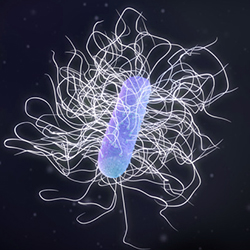
Hardy Diagnostics released a new enrichment broth to detect and identify Candida auris from skin and environmental samples. The medium is based on the CDC formulation for Sabouraud Salt Dulcitol (SSD) Broth with chloramphenicol and gentamicin (J Clin Microbiol 55:2996–3005).
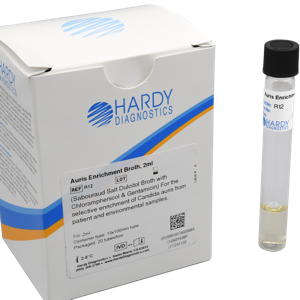
The medium, sometimes referred to as Salt SAB Broth, maintains a lower pH to encourage the growth of fungal isolates. The broth contains dulcitol as the sole carbon source, and chloramphenicol and gentamicin as selective agents against unwanted bacterial growth. Peptones provide nitrogen and amino acids.
The CDC protocol recommends this broth for surveillance of C. auris from skin swabs and environmental samples. Positive broth samples may be subcultured to chromogenic media, such as HardyCHROM Candida + auris (Cat. no. G343), for further identification. Suspect colonies with a teal-to-teal-green “bullseye” center will fluoresce on this chromogenic medium and can be confirmed on the MALDI-TOF.
Although the organism often presents fewer virulence factors than Candida albicans, C. auris may persistently colonize the skin and hospital environment, making its transmission within and among healthcare settings more difficult to control.
C. auris fungemia results in a wide range of mortality rates (from 32%-66%), depending upon the patient’s overall condition, underlying disease, geographic region, access to medical care, and age. A review of the organism's genome demonstrates it harbors genes well-characterized as virulence factors in other Candida species, as well as genes for biofilm production and MDR transcription factors. C. auris may persist on environmental surfaces in healthcare settings and has been cultured from multiple locations in patient rooms. The organism exhibits some degree of tolerance to disinfectants, allowing it to survive on surfaces for greater than three weeks. It can be found on high-touch surfaces near the patient’s bedside, such as tables, rails, and carts; mobile or reusable equipment shared between patients such as blood pressure cuffs, glucometers, temperature probes, and ultrasound machines; and even on surfaces further away from the bedside such as windowsills (J Hosp Infect 2023;137:17-23).
Environmental disinfection procedures should include routine cleaning and disinfection of patient rooms, as well as mobile and reusable equipment. Fungicidal disinfectants should be used following the manufacturer's directions. Environmental sampling may be useful in instances of outbreak investigations, surveillance, or to determine the reservoirs of ongoing transmission.
From company press materials.