

By IDSE News Staff
The CDC confirmed four human cases of highly pathogenic avian influenza (HPAI) A(H5) virus infection in Colorado. The CDC also is aware of a fifth presumptive-positive case in Colorado that will be confirmed at the CDC once the specimen arrives.
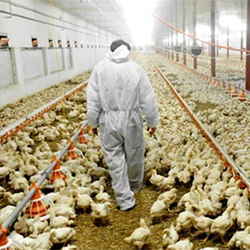
All cases were in farm workers who were involved in the depopulation of poultry at a poultry facility experiencing an outbreak of HPAI H5N1 virus. A CDC team is on the ground in Colorado, supporting their assessment of the poultry outbreak and associated human cases.
These cases again underscore the risk for exposure to infected animals. There are no unexpected increases in flu activity otherwise in Colorado, or in other states affected by H5 bird flu outbreaks in cows and poultry, the agency said.
The workers reported symptoms after being exposed to H5N1 virus–infected poultry. All workers who tested positive reported mild illness. The workers reported conjunctivitis and eye tearing, as well as more typical flu symptoms of fever, chills, coughing and sore throat/runny nose.
The CDC has deployed a multidisciplinary bilingual field team of nine people including epidemiologists, veterinarians, clinicians and an industrial hygienist to Colorado to support their public health response to the outbreak among poultry farm workers. There is ongoing monitoring of workers as part of this assessment, and additional specimens are being tested.
These are the first cases of H5 virus infection in poultry workers (as opposed to dairy workers) since 2022. The first U.S. case of H5 in a poultry worker was reported in Colorado during April 2022. On July 3, 2024, Colorado also reported a case of H5 in a dairy worker on an affected farm, so that state is experiencing ongoing H5N1 outbreaks on dairy and poultry farms.
The designation of the influenza virus neuraminidase (the N in the subtype) is pending influenza genetic sequencing at the CDC. Attempts to sequence the virus in the clinical specimens are underway and will be made available within one to two days if successful. Additional analysis will look for any genetic changes to the virus that could alter the agency’s risk assessment.
The CDC’s recommendations related to H5 have not changed at this time.
Additional cases may be reported and subsequently confirmed as monitoring and testing is ongoing.