







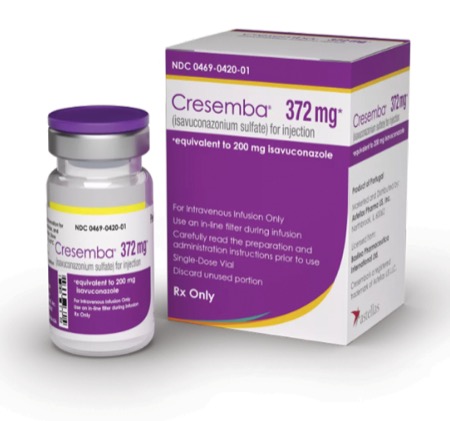
Although isavuconazonium sulfate (Cresemba, Astellas) has been indicated for adults with invasive aspergillosis and mucormycosis since 2015, the FDA expanded the label indication to include children 12 months of age and older in 2023. This was opportune timing. The number of pediatric invasive fungal infections is increasing as more children are surviving aggressive immunosuppressive and cytotoxic therapies, and being treated with broad-spectrum antibiotics and hematopoietic stem cell transplants (HSCTs) (Drugs Context 2024;13:2023-9-2. doi:10.7573/dic.2023-9-2). Here are five points to consider when using isavuconazonium in pediatric patients.
1. Its pharmacokinetics are understood.
Research has shown that the drug dosing is on target and results in similar exposure to adults. In the phase 1 study of isavuconazonium in children, the research team, led by Antonio Arrieta, MD, a clinical professor in the Department of Pediatrics at the University of California, Irvine, and an infectious diseases specialist at Rady Children’s Health, in Orange, Calif., found that predicted plasma drug exposures were within the target range of greater than 80% and greater than 76% (Antimicrob Agents Chemother 2021;65[8]:e0029021). “It has a predictable PK [pharmacokinetic profile],” Dr. Arrieta told Infectious Disease Special Edition.
2. It demonstrated good safety.
That same study, along with other research has found that isavuconazonium, a prodrug of the azole antifungal isavuconazole, is well tolerated in pediatric patients. Kunvarjee et al, in a single-center retrospective study of pediatric oncology and HSCT patients, found adverse events were not related to the drug in their study population (J Pediatr Hematol Oncol 2024;46[2]:e143-e146). Similarly, Ross et al found that only four of 18 patients had elevated alanine aminotransferase levels three times that of baseline within 30 days of isavuconazonium treatment, with none experiencing elevated bilirubin or increases in serum creatinine (J Pediatr Hematol Oncol 2020;42[4]:261-265).

Dr. Arrieta, who also is the senior researcher on the phase 2 pediatric trial, said the drug has “excellent safety.” In that multicenter, international, noncomparative trial, only two of the 31 patients enrolled discontinued treatment due to drug-related adverse events (Antimicrob Agents Chemother 2024;68[12]:e0048424).
3. It is available as an oral treatment.
Although administration by injection is approved for children 12 months and older, children older than 6 years who weigh at least 16 kg also can receive oral therapy. Dr. Arrieta explained to IDSE that the drug has “excellent oral bioavailability allowing for oral treatment.” The oral capsules can be taken with or without food and should be swallowed whole, according to the product label.
If administered by injection, isavuconazonium can be given as an IV infusion set with an in-line filter over a minimum of one hour. Isavuconazonium should not be given as an IV bolus injection and should not be infused with other medications. Alternatively, it also can be administered through a nasogastric tube in patients 6 years and older who weigh 16 kg or more.
If needed, healthcare professionals can switch between IV and oral administration without a new loading dose, as bioequivalence has been shown. Refer to the package insert for more information on dosing and administration.
4. Treatment can be a success.
Research has shown isavuconazonium’s benefit in children with proven or probable invasive fungal infections. In the phase 2 pediatric trial, of the 31 patients enrolled—most of whom had underlying hematologic cancers—the researchers found an overall successful response rate in 54.8% of patients. All-cause fatality at day 42 was 6.5%. “In a noncomparative trial, it showed good activity against proven/probable aspergillosis in immunocompromised children,” Dr. Arrieta said. “There are several reports of success in treating Mucor infections, but it has not been studied formally in children for this indication.”
In Kunvarjee et al, in 20 pediatric patients receiving isavuconazonium prophylactically, one patient had a proven breakthrough invasive fungal infection and two had probable/possible infections. Ross et al found that at 90 days, 54% of their study population of pediatric patients with probable or proven invasive fungal infection (n=11) had a partial or complete response to treatment.
5. More research is needed.
Even with the increasing number of fungal infections, Dr. Arrieta said the data are still limited on isavuconazonium use in pediatrics, and he hopes more people will explore this newer pediatric treatment.
Dr. Arrieta reported no relevant financial disclosures.
This article is from the October 2025 print issue.