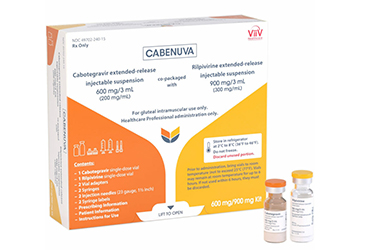
Many people with HIV want to transition from viral suppression with daily oral dolutegravir-lamivudine (DTG/3TC; Dovato, ViiV Healthcare) to long-acting injectable cabotegravir + rilpivirine (CAB+RPV LA; Cabenuva, ViiV Healthcare), and they can do so successfully, according to new research presented at IAS 2025, in Kilgali, Rwanda.
In the data from the phase 3b, multicenter, nonrandomized, parallel-group, open-label implementation-effectiveness VOLITION study (abstract WEPEB033), patients who were naive to antiretroviral therapy and had an HIV-1 RNA count of 1,000 copies/mL or higher, were started on DTG/3TC to suppress their HIV load (N=171). After achieving an HIV RNA count below 50 copies/mL, which could occur anywhere from weeks 4 to 16, patients were eligible to switch to CAB+RPV LA dosed every two months or continue on DTG/3TC. Patients were then evaluated at month 11/12, with co-primary end points of time to virologic suppression from baseline and proportion of patients with HIV-1 suppression per snapshot algorithm at month 11. Secondary end points included the proportion of patients with suppression over time, the proportion of participants with confirmed virologic failure and resistance, safety and tolerability, change in CD4+ count over time, and patient-reported outcomes.
The researchers defined virologic failure as consecutive plasma HIV-1 RNA values of at least 200 copies/mL after prior suppression to 50 copies/mL, and they defined virologic nonresponse as either having plasma HIV-1 RNA levels decrease by less than 1.0 log10 copies/mL by week 12 or a level of 200 copies/mL or greater on or after the “day of choice” with no history of suppression and confirmation upon retest. The researchers measured HIV-1 RNA with the Roche cobas 6800 assay, but additional testing for incongruous results used the Abbott RealTime HIV-1 assay. The data presented at IAS 2025 used the Abbott results, the researchers noted.
In the trial, patients were a median of 31 years of age (range, 18-70 years of age), and 26% identified as female. The majority of patients were from North America (46%), with the remainder from Europe (27%) and South America (27%). Most were white (62%), followed by Black or African American (30%), and about half (51%) identified as Hispanic or Latinx. At the start of the trial, the median HIV-1 RNA plasma counts was 57,100 copies/mL (IQR, 21,200-174,000 copies/mL), and 9% had a baseline plasma of 500,000 copies/mL or greater. Likewise, the median CD4+ count was 396 cells/mm3 (IQR, 252-543 cells/mm3), and 16% had a baseline CD4+ count more than 200 cells/mm3.
97% Suppression With DTG/3TC
The researchers found that almost all of the patients achieved virologic suppression within the 16-week suppression phase of the trial (167/171; 97.7%). The median time to suppression was 4.1 weeks (95% CI, 4.1-4.3 weeks). Only one participant experience virologic failure without treatment-emergent resistance.
Patients with higher baseline viral load had a longer median time to suppression. For the 106 patients with counts under 100,000 copies/mL, median time was 4.14 weeks. For the 50 patients with counts no more than 100,000 to 500,000 copies/mL, median time was 4.64 weeks. For the 15 patients with counts of 500,000 copies/mL or higher, median time was 8.29 weeks. That difference was not seen in baseline CD4+ counts (<200 cells/mm3: 4.14 weeks; 95% CI, 4.14-8.14 weeks; 200 to <350 cells/mm3: 4.29 weeks; 95% CI, 4.12-7.86 weeks; ≥350 cells/mm3: 4.14 weeks; 95% CI, 4.14-4.29).
In terms of drug-related adverse events (AE), 10% of the study participants had a grade 1 or 2 AE. There were no grade 3 or higher AEs. Only one participant withdrew due to an AE. This was consistent with the known safety profile of DTG/3TC, the researcher wrote.
Open to Switching
Study participants were asked at baseline whether they could consider switching treatment at the “day of choice,” and 85% (101/119) of those who responded that they had considered the switch said they expressed interest in switching. Then on the “day of choice,” 89% (129/145) of eligible participants chose to switch to CAB+RPV LA.
The most common reasons cited for switching were not having to worry about missing a dose each day (80%) and not having to carry medication (68%) (abstract EP0170).
Overall, the study findings show the benefits of DTG/3TC and the value of offering CAB+RPV LA as a treatment option for patients.
“Data from the VOLITION study highlight how providing choice in HIV care empowers individuals to choose medicines that meet their evolving everyday needs,” said Jean van Wyk, MBChB, MFPM, the chief medical officer at ViiV Healthcare, in a press release. “Long-acting injectables provide options that can offer high effectiveness and tolerability, improved adherence, and a preferred dosing schedule compared with daily oral pills. We believe they are a key part of HIV treatment and prevention and will play a critical role in achieving our ambition of ending HIV and AIDS.”
The study was funded by ViiV Healthcare. Reporting was based in part on a ViiV press release.