





Originally published by our sister publication Pharmacy Practice News
By Gina Shaw
A retrospective case series study of immunocompromised patients with active herpes zoster infections who presented for care with skin lesions and subtle neurologic manifestations found that 100% had a positive test for the virus in their cerebrospinal fluid (CSF), reported the study’s authors at IDWeek 2024, in Los Angeles (poster P-910).
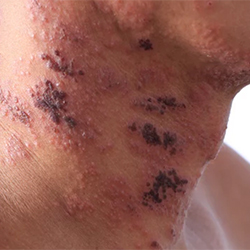
“Subtle signs of VZV [varicella-zoster virus] infection of the CNS [central nervous system] can be misleading and easily mistaken for more benign conditions,” said Estefania Sienra-Iracheta, MD, of the infectious disease department at Hospital General Dr. Manuel Gea González, in Mexico City. “It is estimated that VZV CNS involvement might be underreported in immunocompromised individuals, and has been estimated to be approximately 2 to 4 per million per year. In high-risk populations, zoster awareness of atypical presentations is crucial to avoid progression to severe, irreversible CNS damage” (Curr Opin Infect Dis 2020;33[3]:273-278).
The study, conducted from January 2023 to August 2024 at two hospitals in Mexico City, analyzed clinical data, CSF analysis and treatment outcomes for 31 patients, who were primarily male (77%) with a mean age of 46 years. Most patients had advanced HIV, while others had cancer, diabetes, liver disease, chronic kidney disease, autoimmune disease or chronic steroid use.
“Most patients presented with subtle clinical CNS infection manifestations,” Dr. Sienra-Iracheta said. While 65% of patients presented with headache, far fewer had more concerning presenting findings such as fever (22%), somnolence (22%) or confusion (16%). All patients received IV acyclovir for an average of 10 days, with a 93.6% survival rate at 90 days.
“Subclinical aseptic meningitis has been reported in 40% to 50% of patients with VZV and headache,” she noted. “A study of 50 immunocompetent patients with VZV found abnormal CSF in 61% without signs of meningeal irritation, encephalitis or myelitis.”
Because these subtle neurologic symptoms may be the first clinical sign of CNS infection, Dr. Sienra-Iracheta recommended that CSF testing be conducted in all immunocompromised individuals with shingles. “We recommend early treatment with intravenous acyclovir and timely VZV vaccination for these individuals, to prevent unfavorable outcomes.”


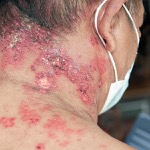
The study serves as an important cautionary note to providers managing immunosuppressed patients with shingles, said Patricia Fulco, PharmD, BCPS, a clinical pharmacy specialist in internal medicine and HIV care at Virginia Commonwealth University (VCU) Health System, in Richmond. “If someone presents with symptoms like somnolence or confusion, I would assume that most providers would obtain the LP [lumbar puncture], but you might not always think to get CSF if someone presents with a headache alone. These findings tell us that we definitely should consider this. It’s also worth noting that the CSF characteristics were not necessarily always that elevated; the mean CSF protein was 72, although the range was up to 269, and the mean glucose was 58. These weren’t findings with highly significant abnormalities, but the PCR [polymerase chain reaction] was 100% positive.”