

By Marie Rosenthal, MS
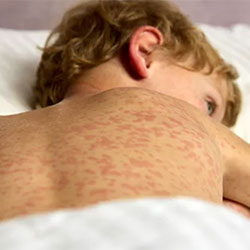
A second unvaccinated person—this time in New Mexico—died during the current measles outbreak.

Although the New Mexico Department of Health (NMDOH) confirmed the deceased resident of Lea County tested positive for measles, the official cause of death is still being investigated by the New Mexico Office of the Medical Investigator because the person did not seek medical care before dying. However, NMDOH Scientific Laboratory has confirmed the presence of the measles virus, according to the NMDOH.
This new case brings the total number of New Mexico cases to 10. All cases have been in Lea County residents. Cases have included six adults and four children younger than 17 years of age. Seven of the cases were unvaccinated, while the remaining three have unknown vaccination histories.
Lea County has a 94% vaccination rate for at least one dose of the measles-mumps-rubella vaccine for ages 18 and under, and the state rate is 95%, according to David Morgan, the NMDOH public information officer.
The measles first death in a decade was reported by the Texas Department of State Health Services, which occurred in an unvaccinated child in the South Plains and Panhandle regions—areas with very low vaccination rates.
Texas is experiencing the largest outbreak among all states with measles cases. As of March 7, 208 cases have been reported in Texas, according to the CDC, which issued a health alert warning clinicians, public health officials and travelers about the outbreak.
Most of the cases are among unvaccinated people.
Measles is highly contagious; 1 in 5 cases requires hospitalization, and approximately three in every 1,000 cases result in death, according to a release by the NMDOH. Vaccination has become a priority in both states. Public health officials in both states are urging residents to get vaccinated to protect themselves and their families.
“The measles-mumps-rubella vaccine is the best protection against this serious disease,” said Chad Smelser, MD, the NMDOH deputy state epidemiologist.
Public Health Experts Concerned
“The recent outbreak in Texas as well as smaller outbreaks in Pennsylvania, New Hampshire and Oregon are extremely concerning. An elementary age child from Texas last month was the first child to die from measles in the U.S. in 10 years, and we are waking up to news of a second death,” said Matifadza Hlatshwayo Davis, MD, MPH, FIDSA, the director of Health for the City of St. Louis, and a member of the board of directors of the Infectious Diseases Society of America (IDSA) during a media briefing on March 7.
“Local health departments are being impacted negatively because messaging from the top down, which has given in some cases credence to people pushing vaccine misinformation and disinformation,” she said. Her state has seen an increase in kindergartners entering school without their vaccines. “Here in Missouri, nearly 10% of Missouri kindergartners are not vaccinated,” she added, so the concern of a measles outbreak is high.
Measles has been eliminated since 2000, reminded Dial Hewlett Jr., MD, FACP, FIDSA, the medical director, Division of Disease Control, and the chief of Tuberculosis Services at the Westchester Department of Health, in New York. “When I was completing my fellowship here in the New York area back in the 1980s, the attending physicians said to me, ‘You’ll never see a case of measles.’ And so I thought at that time that we were never going to see measles, but we ended up seeing it,” he said during the IDSA briefing.
The misinformation about the safety of the measles vaccine stems primarily from “fraudulent” research by Andrew Wakefield linking the MMR vaccines with autism, Dr. Hewlett said. (Robert F. Kennedy Jr., the secretary of Health and Human Services, is among those claiming against evidence there is a link between autism and the MMR vaccine. Despite recent cuts in funding and several outbreaks to manage, the CDC reportedly is launching a large study to reinvestigate this alleged link between the MMR vaccine and autism.)
“I think that we and the infectious disease community and the medical community know that the measles vaccination is our first line of defense against measles in children and also in adults. And we strongly encourage everyone to have those vaccinations, and the lack of those vaccinations results in the increased risk for measles. Measles is extremely contagious. One case of the measles is likely to result in 12 to 18 new cases of the measles,” Dr. Hewlett said.
“And we know that the measles is not a benign disease that, that many of the children require hospitalizations because of measles pneumonia and also measles can cause encephalitis,” Dr. Hewlett said.
Mr. Kennedy said he was sending cod liver oil, which is rich in vitamin A, to help fight the outbreak in Texas because it reduces mortality.
“I want to reinforce that vitamin A is not a replacement for vaccination,” Dr. Davis said. “The measles-mumps-rubella vaccine is the only reliable way to prevent measles. Secondly, it’s important to note that vitamin A supplementation has been shown to reduce measles mortality in malnourished populations, in resource-limited countries where deficiencies are common.
“However, in well-nourished populations, the benefits are unclear,” she said.
Finally, she reminded that high doses of vitamin A therapy carry safety risks, including toxicity, liver damage and increased intracranial pressure.
“So, while vitamin A may support treatment in severe cases, it does not stop the spread of measles or provide long-term protection. Only vaccination can do that,” Dr. Davis said.