This article was update 9/19/2025 at 9:52 am to reflect the revision for the Vaccines for Children vote.
By Gina Shaw
In a highly contentious Sept. 18 meeting, the CDC’s Advisory Committee on Immunization Practices (ACIP) voted to withdraw its longstanding recommendation for the combined measles-mumps-rubella-varicella (MMRV) vaccine in children younger than 4 years of age. The panel’s 8-to-3 vote, with one abstention, reverses 15 years of policy.
But in a confusing turn, ACIP then rejected a separate resolution that would have aligned the federally funded Vaccines for Children (VFC) program with its new guidance. That vote—1 in favor, 8 opposed, 3 abstaining—appears to mean that VFC will continue to cover the combined vaccine in younger children even as ACIP discourages its use. That vote was later revised Friday, Sept. 19 to align with the vote to remove the MMRV recommendation for children younger than 4 years of age. See story here.
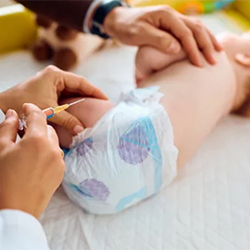
Currently, children receive two doses of MMR vaccine and two doses of varicella vaccine, typically at 12 months to 15 months and again at 4 to 6 years of age. Parents have the option of giving these as two separate injections (MMR and varicella) or as a single combined shot (MMRV). ACIP’s new vote means that children younger than 4 years will be steered toward the two separate shots rather than the combination product, even if their parents or guardians prefer a combined dose.
The meeting was the second since Health and Human Services Secretary Robert F. Kennedy Jr. removed all of the prior members and replaced them with a panel that includes multiple individuals associated with anti-vaccine organizations and sentiments.
The dual votes left many participants baffled. “If ACIP does not recommend a vaccine, it will not be covered by the Vaccines for Children program,” Jeanne Santoli, MD, the chief of the Vaccine Supply and Assurance Branch of the CDC’s National Center for Immunization and Respiratory Diseases, had reminded panelists earlier in the day. But after the votes, she and others acknowledged the practical contradiction.
Several members conceded they were unclear about how the decision would play out in practice, underscoring what one participant called “how rushed the whole thing was.”
Meanwhile, a planned vote on the birth dose of the hepatitis B vaccine for infants was put off until Sept. 19.
Review on MMRV Safety
John Su, MD, PhD, the acting director of the CDC’s Immunization Safety Office, reviewed safety data from multiple U.S. and European studies. The evidence was consistent: The first dose of MMRV vaccine in children 12 months to 23 months of age carries about twice the risk for a febrile seizure compared with receiving the MMR and varicella vaccines separately.
A systemic review and meta-analysis, which included studies that looked at children as young as 9 months found no evidence of a significant difference in the incidence of febrile seizure or febrile seizure related to vaccination between those vaccinated with MMRV and MMR with or without varicella given separately (Vaccine 2015;33[31]:3636-3649). “Receipt of concomitant MMRV and other pediatric vaccines was not a significant predictor of febrile seizure,” Dr. Su said.
A post-marketing review that included data from eight post-marketing studies involving more than 3.2 million children found a twofold increase in risk for seizure or febrile seizure during seven to 10 days or five to 12 days after receiving MMRV vaccine among children ages between 10 months to 24 months, he added.
Cody Meissner, MD, tried to put it into perspective. “More than 95% of febrile seizures occur before age 4,” said Dr. Meissner, a professor of pediatrics at the Geisel School of Medicine at Dartmouth, in Hanover, N.H., who previously served on ACIP and was reappointed to the panel by Mr. Kennedy. “So, the increased risk is confined almost entirely to that younger group.”
Dr. Meissner stressed that context matters. “Febrile seizures occur in 3% to 5% of all children, and every pediatrician is familiar with them. The prognosis is excellent,” he said. “We should not exaggerate the risk of these events, but we also need to be clear about them with families.”
Studies in older children have consistently shown no increased risk for febrile seizures. During the meeting, CDC staff presented data from Merck-sponsored clinical trials among children 4 to 6 years of age demonstrating that not a single febrile seizure was observed in either the MMRV or separate vaccine arms. Post-licensure surveillance confirmed those findings, estimating the absolute risk at about one febrile seizure per 86,750 doses.
Martin Kulldorff, PhD, the committee’s new chair, asked whether “unnecessary” seizures—however rare—could undermine public trust. “How much does having a child with a febrile seizure affect the parents’ willingness to give vaccines to their other children or to vaccinate cousins or kids in the preschool?” he asked. “That affects the country. It’s not just the number of needles. One unnecessary febrile seizure can ripple through a community.”
Kirk Milhoan, MD, PhD, a pediatric cardiologist from Hawaii, put it more bluntly: “A seizure happening to a family for 15 minutes is an enormously long time. Do I see families excited to get the next vaccine after that? No. Am I excited to give it? No.”
Change Does More Harm Than Good
But Dr. Meissner urged colleagues not to overreact: “We know that the prognosis after febrile seizures in childhood is excellent. The major concern is the anxiety it generates in other family members. And that’s entirely understandable—it’s a very frightening experience. But we are very comfortable in saying that a febrile seizure is not associated with any sort of impaired performance or neurocognitive development or school problems.” He noted that febrile seizures unrelated to vaccines are very common in children and typically benign.
He also reminded the panel that the ACIP wrestled with this exact issue 15 years ago, ultimately concluding that both approaches were acceptable. “This is really déjà vu,” he said. “We calculated at the time that a busy pediatrician might see one patient with a febrile seizure attributable to MMRV every few years. The American Academy of Pediatrics [AAP] recognized that risk but did not express a preference for splitting the vaccines. The decision was to provide parents with choice.”
That emphasis on choice was echoed by representatives of major medical and public health groups, who warned that removing the combined product would cause more harm than good.
Jason Goldman, MD, the president of the American College of Physicians, argued that the committee was skipping the established “evidence to recommendation” framework: “This recommendation is going to create more confusion among the public,” he said. “You are taking away the choice of parents to have informed consent and discussion with their physician. And when you make this recommendation, you give license to insurance companies and the Vaccine for Children program not to cover this vaccine.”
Robert Hopkins Jr., MD, the medical director of the National Foundation for Infectious Diseases, agreed, adding: “We’ve not considered issues around equity, or the implications of these decisions for practicing physicians. Those are missing elements.”
Several speakers emphasized that the recommendation would not only remove an option but also complicate an already strained vaccination landscape. Dr. Meissner noted that while most parents are already choosing separate doses—about 85%—there are still 15% who prefer the combined vaccine. If ACIP recommends against it, he said, those families will lose that option.
Judith Shlay, MD, a family physician at the Public Health Institute at Denver Health representing the National Association of County and City Health Officials, highlighted the practical burden. At the 12-month visit, infants may receive up to seven vaccines in a single appointment. “Some parents want fewer injections,” she said. “For them, the combination vaccine makes sense.”
Amy Middleman, MD, speaking on behalf of the Society for Adolescent Health and Medicine, warned that undermining vaccine confidence now is particularly risky, given already eroding coverage rates. “A public health recommendation should never be based on anecdotal evidence,” she said. “Public health providers have to worry about the health of the entire public.”
In a separate Zoom briefing held by the AAP toward the end of the ACIP meeting, Sean O’Leary, MD, the director of the Colorado Children's Outcomes Network, said the renewed debate over MMRV was “another strategy to scare parents” by putting “vaccines and seizures in the same sentence.” He stressed that families should have the option to choose. “The decision is simple: one less injection with a slightly higher but rare risk of a benign febrile seizure, or separate doses with a slightly lower risk,” he said. “ACIP’s vote will take away that choice.” He also warned of the strain on already overburdened practices: “Our primary care colleagues and primary care practices are understaffed right now. Anything we do has to think about the potential impacts on the day-to-day primary care provider.”
A Panel in Uncharted Territory
Today’s vote marks the first time ACIP has recommended against a vaccine long considered global standard of care; a similar vote is expected Sept. 19 when the look at the birth dose of hepatitis B vaccine. That break has deepened the rift between the committee and the broader public health community.
The AAP declined to appear at the meeting in protest, a move that Dr. Meissner called “a grave mistake” that risked making the academy “irrelevant.”
In his briefing, Dr. O’Leary pushed back against that charge. He said the AAP and other liaison members had been “disinvited from work groups,” which are the real venues where policy is shaped, and that ACIP leadership was falsely invoking Federal Advisory Committee Act rules to justify excluding them against longstanding practice. “It’s not us that is putting this barrier between ACIP and AAP,” he said. “It’s HHS.”
During the meeting, Dr. Middleman urged the committee to reconsider this exclusion of liaison members from ACIP working groups, stressing the practical knowledge and patient representation they bring, including “a wealth of knowledge” on issues such as neonatal vaccination practices and vaccine adjuvants, on which ACIP panel members had earlier demonstrated some confusion. She argued that their involvement would ensure the committee is making recommendations with the fullest range of expertise at the table. “How can we make sure that we add the liaison members back into the working group so that they can contribute on behalf of their patients and their knowledge base?” she asked.
Dr. O’Leary acknowledged that the AAP wrestled with whether to attend, but concluded that this ACIP panel is “illegitimate” and that participating would have conferred credibility on a process “designed to promote false claims and junk science.”
Just a day earlier, former CDC director Julie Monarez, MD, told the U.S. Senate Committee on Health, Education, Labor and Pensions that ACIP’s reconstitution under Mr. Kennedy has undermined global confidence in U.S. vaccine leadership. “What we are witnessing,” she testified, “is the replacement of rigorous science with ideological theater. If the United States abandons evidence-based vaccine policy, the consequences will reverberate worldwide.”