California has responded to the ongoing avian influenza (H5N1) outbreak by monitoring human and animal activities, testing wastewater and raw milk, and even testing for the virus in cats, said its public health laboratory director Anthony Tran, DrPH, MPH, D(ABMM). Speaking at the ASM Microbe 2025 meeting, in Los Angeles, Dr. Tran said this was the first time that a One Health approach to infectious disease management has been incorporated into a statewide emergency response.
There have been 70 confirmed U.S. human cases of H5N1 since April 2024, Dr. Tran explained.
“We’ve taken the lion’s share of that here in California,” Dr. Tran pointed out, with 38 confirmed and one probable case. Most U.S. cases are mild, he noted, but there have been four hospitalizations and one death.
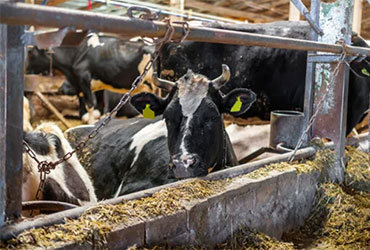
Dr. Tran said California is the state with the largest agricultural industry in the United States, with confirmed cases of H5N1 in more than 766 cattle herds. California public health officials quarantined those herds to prevent infected milk from entering the food supply. As of the ASM Microbe meeting, Dr. Tran said more than 80% of the herds were removed from quarantine once H5N1 was no longer detected in milk from cows in the herd.
“This actually meshed a lot with data we had seen from other states, with the—pun intended—herd immunity of the cattle being infected and then leveling off in terms of immunity from H5N1,” Dr. Tran remarked.
He also noted that 37 human avian influenza cases (36 confirmed cases and one probable case) in California were in farmworkers, suggesting some cattle-to-human transmission as farmworkers handled infected milk. The hemagglutinin protein on H5N1 binds to receptors that allow for interspecies transmission, Dr. Tran said (Cell 2025;188[4]:919-929.e9).
As H5N1 cases in cattle stabilized, evidence of the virus also began to decline in wastewater.
“This [wastewater surveillance] is not only an early warning system, we feel, but it coincided at this time with what was actually happening in the cattle,” Dr. Tran said.
Wastewater surveillance capacity was relatively straightforward to increase, Dr. Tran noted, by making this a focus at the state’s own laboratories and partnering with private industry. Testing for H5N1 in raw milk was harder, he acknowledged, as there are no established protocols for public health laboratories doing this. Raw milk is allowed to be produced and sold within California state lines, Dr. Tran said, causing some of his colleagues to proactively test for H5N1 in raw milk supplies. The FDA does not allow sale of raw milk across state lines because it could be contaminated, Dr. Tran noted.
Given the lack of standard protocols for testing for H5 in milk at public health laboratories, the first protocol was for influenza A virus in general, and the state now has an H5-specific subtyping assay. This work led to several raw milk recalls in California in November and December 2024.
“We have also started to find H5N1 in cats,” noted Dr. Tran, as further evidence of the state’s One Health approach to surveillance. Cats are also susceptible to H5N1 from raw milk or food.
If a cat with an encephalitic neurologic illness potentially indicating flu dies and tests negatively for rabies, public health officials then test for H5N1. Thus far, this has yielded 21 cases of confirmed H5N1 infection in domestic cats. Detection of H5N1 infection in cats is considered a potential harbinger of a larger influenza problem.
Dr. Tran said California plans to continue intensive H5N1 surveillance.