By Gina Shaw
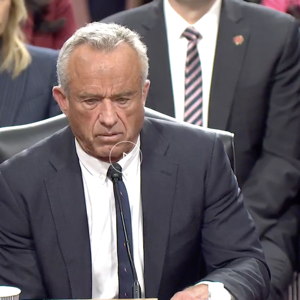
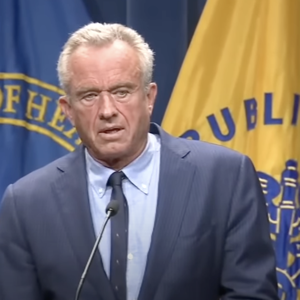
Health and Human Services Secretary Robert F. Kennedy Jr. announced the “Make Our Children Healthy Again Strategy” (MAHA Strategy) agenda that touches on many topics, including targeting vaccination for intense levels of scrutiny.

The strategy document, released on Sept. 9, 2025, includes four pillars, which are not really new to public health:
- advancing research
- realigning incentives
- fostering private sector collaboration
- increasing public awareness
It points to “four potential drivers behind the rise in childhood chronic disease that present the clearest opportunities for progress,” including poor diet, chemical exposure, lack of physical activity and chronic stress, and “overmedicalization,” citing “a concerning trend of overprescribing medications to children, often driven by conflicts of interest in medical research, regulation, and practice.”
Potential vaccine injury is a prominent component of the section on research. It notes that “HHS, in collaboration with NIH [National Institutes of Health], will investigate vaccine injuries with improved data collection and analysis, including through a new vaccine injury research program at the NIH Clinical Center that may expand to centers around the country.”
In a later section on policy reforms, the strategy document proposes a “vaccine framework,” which it says will be focused on:
- ensuring America has the best childhood vaccine schedule;
- addressing vaccine injuries;
- modernizing American vaccines with transparent, gold-standard science;
- correcting conflicts of interest and misaligned incentives; and
- ensuring scientific and medical freedom.
In a presentation on Sept. 9, Mr. Kennedy claimed that “we are now the sickest country in the world,” noting that the CDC had announced earlier in the week that 76.4% of Americans are suffering from a chronic disease. “We have the highest chronic disease burden of any country in the world, and yet we spend more on healthcare than any country in the world,” he said. “We spend nearly as much in our country for healthcare as all the other nations in the world combined. And yet we have the worst health outcomes.”
He pointed to trends such as increased prevalence of diabetes in children, increased diagnoses of autism and rising rates of obesity. “This is an existential crisis for our country,” he said.
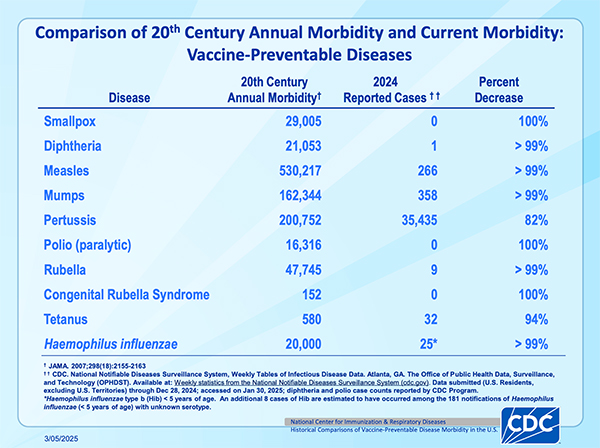
According to the CDC, vaccination has prevented the deaths of millions of people in the 20th century in the United States alone. As an example, measles took more than 530,000 people in the 1900s versus none in 2024. (See tables. There were three deaths in 2025 among unvaccinated people; two were children. They are not reflected in these tables.)
The accomplishment has been seen, not just in the United States but throughout the world. Since 1974, 154 million deaths have been prevented through vaccination. This figure includes 146 million children: 101 million were younger than 12 months of age. Forty percent of the decline in global infant mortality since 1974 is due to vaccination (Lancet 2024;403[10441]:2307-2316).
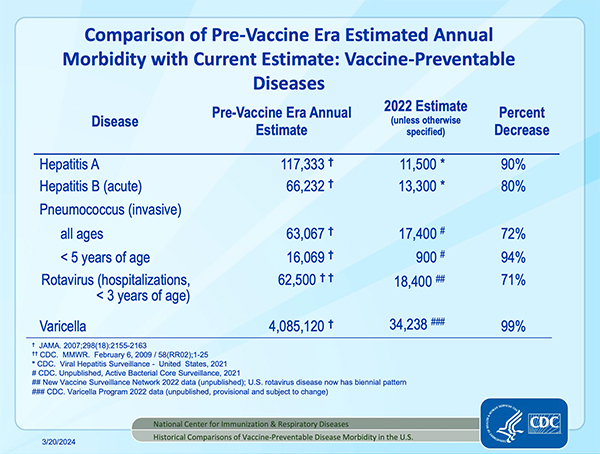
However, the MAHA Strategy document is not only vague about how it will address these challenges, but also specifically hostile toward the vaccines that have helped dramatically reduce or even eradicate vaccine-preventable diseases like polio, mumps, measles and diphtheria in the United States, according to Paul Offit, MD, the director of the Vaccine Education Center at Children’s Hospital of Philadelphia.
“They have a laundry list of problems, but they don’t define what it is that they’re planning to do about those problems and how they’re going to do it. When RFK Jr. says they’re going to look more carefully at ‘vaccine safety,’ he means that they want to find data that comports with their fixed, immutable beliefs about vaccine injuries. They believe that vaccines cause chronic diseases, period. They are going to find studies, no matter how poorly performed, how methodologically flawed, how uninterpretable, and they will then hold those up and use phrases like ‘landmark study’ and ‘gold-standard science,’ and say we figured this out.”
In a Sept. 9 hearing on vaccine science before the Senate Permanent Subcommittee on Investigations, Mr. Kennedy’s adviser, Aaron Siri, cited a years-old, still-unpublished study known as the Henry Ford Health System analysis, which he said had been “suppressed” because it shows that vaccinated children have dramatically higher rates of chronic conditions than unvaccinated children.
But the only physician to testify in the hearing, Jake Scott, MD, a clinical associate professor of infectious diseases and geographic medicine at Stanford University School of Medicine, in California, noted that the study remained unpublished because of significant design flaws. “The study … notes substantially lower healthcare use among never-vaccinated children, ensuring fewer opportunities to record diagnoses,” he said. “Despite these biases, no association with autism was observed. These findings reflect differences in follow-up and healthcare contact, not vaccine harm.” https://www.hsgac.senate.gov/wp-content/uploads/Scott-Testimony.pdf
One of the most recent studies on vaccine safety, a large Danish cohort study investigating the association between cumulative aluminum exposure from vaccination within the first two years of life and risk for 50 chronic autoimmune, atopic or allergic, and neurodevelopmental disorders, found no evidence suggesting an increased risk for any of those disorders (Ann Intern Med 2025 Jul 15. doi:10.7326/ANNALS-25-00997).
The United States already has several surveillance systems in place to find adverse events that can be linked to vaccines, according to Walter Orenstein, MD, a professor of medicine (emeritus) at Emory University School of Medicine, in Atlanta; former associate director of the Emory Vaccine Center; former director of the US National Immunization Program; and former assistant surgeon general of the U.S. Public Health Service. “We do have a comprehensive vaccine safety evaluation study in the United States, which has been able to detect even extremely rare events, such as a form of intestinal bowel blockage called intussusception that occurred in about 1 in 10,000 children with the original rotavirus vaccine, Rotashield,” Dr. Orenstein noted. “So that vaccine was removed from the market, and subsequent vaccines had to pass a higher safety threshold to get approved,” he told Infectious Disease Special Edition. “We set up that system to be able to measure both whether a given adverse event following vaccination is causally or coincidentally related, and if causally related, what the attributable risk was compared to the attributable benefits of vaccination.”
Any vaccine reviews undertaken should be done with similar scientific rigor, he said. “That’s my concern about some of the kinds of people who are being tasked with these efforts. They would need to be conducted transparently by a group that has respect in the scientific community, much like the Immunization Safety Review Committee of the National Academy of Medicine, which provided invaluable help in evaluating the scientific data when I was at the CDC. My fear is that they will instead choose people who already have their own conclusions, whether scientifically valid or not, and will not give the data objective review.”
Dr. Offit warned: “Secretary Kennedy’s goal appears to be to make vaccines more feared, less available and less affordable. They are doing exactly that. And we’re going to stand by and watch it happen until enough children suffer or get hospitalized or die that finally Congress gets a backbone and stands up for the American public.”
The announcement and strategy document made no specific mention of infectious diseases, but a statement from the Infectious Diseases Society of America President Tina Tan, MD, noted that infectious diseases and public health experts have a vital role in all efforts to improve children’s health.
Reducing the burden of chronic diseases cannot be done without infectious disease care and research,” she said. “Infectious diseases can contribute to the development of chronic diseases, and those who have chronic conditions are at increased risk for infections. Physicians who specialize in infectious diseases are absolutely critical to preventing and managing chronic diseases.”
Dr. Tan also warned that vaccine policy decisions must be made by objective experts in vaccines. “Any federally funded research into the cause of autism must be based on credible science and not reach premature, inaccurate or preordained non-scientifically based conclusions,” she said. “Decades of scientifically sound research have proven that vaccines do not cause autism and are not associated in any way with autism.”