






Filemon Dela Cruz, MD, a song-and-dance man at heart, loved the theater, and at one point in his life, he thought that is how he would spend it—dancing and singing on the stage. However, after his father died, Dr. Dela Cruz went from the musical stage to staging tumors.
“My father died of metastatic renal cell carcinoma in the late 90s, and he died in the context of an early phase clinical trial. Although it did not have a good ending, that experience was one of the things that motivated me to go into medicine,” said Dr. Dela Cruz, who is a pediatric oncologist at Memorial Sloan Kettering Cancer Center/MSK Kids, in New York City.
“I was a bit lost toward the end of college in terms of what I was going to do in life,” he admitted, but he thought the science of cancer therapy at the time was exciting. It was the beginning of the era of personalized medicine—and he wanted to be a part of that. Today, he not only treats adolescents and young adults with bone cancers, but he also does bench and clinical research.

“I just completed a clinical trial where one of the drugs was a drug that is FDA approved for the type of cancer that my father died of,” he said. “It’s interesting how life kind of intertwines all of these things.”
Although he does not regret his decision, he sometimes misses the stage. While working in a lab at Oregon Health & Science University, in Portland, after graduation, he continued doing shows.
“I got into the community theater scene in Portland, which was actually quite robust, and I ended up doing it professionally for a time,” he explained. “I tried to do it for as long as I could, but there was just no way that you can go to medical school at the same time. Believe me, I tried, but it was sort of ridiculous,” he admitted. “What path was I going to choose? So, obviously I chose medicine, but I still did shows here and there, and I sang for nearly 10 years with the New York City Gay Men’s Chorus.”
But even that became impossible with his patient and research load.
“The last show that I did with them was the 45th anniversary of the Stonewall Riots at Carnegie Hall.”

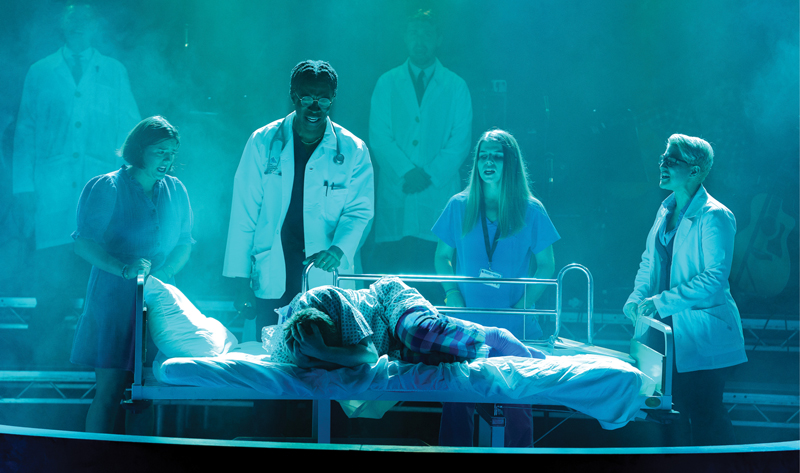
Recently, Dr. Dela Cruz got a second chance at the stage: He sang in the chorus of the show “Lifeline,” a musical about the life of Alexander Fleming and the impact of antimicrobial resistance (AMR), which had a limited run Off Broadway (bit.ly/4eYpYNY-IDSE). Although professional actors had the starring roles, the chorus was composed of healthcare professionals.
It was such an interesting experience, and it brought back many memories, he said.
How the Magic Happened
An email came across his computer asking healthcare workers to audition for the show; two colleagues told him he must audition.
“I signed up. I said, ‘These are the dates that I’m available,’ because they wanted to know availability. And then I didn’t hear from them for several weeks. I thought, ‘OK, whatever. I guess they casted; I know how these things go,’” he said and promptly went back to work.
Out of the blue at the end of July, he got an email from Jessica Conway, a producer, thanking him for signing up and giving him an audition time. The time and place were convenient, so he said he would do it. However, a week before the audition, he was moderating a panel at a conference, and he caught a respiratory infection while he was on the road.
“I lost my voice,” he said. “I kept thinking my voice was going to crack like a 14-year-old” while he was singing “This Is the Moment” from the musical “Jekyll & Hyde,” by Frank Wildhorn and Leslie Bricusse.
He pulled it off, but it was several weeks before he heard from them, so he again figured he didn’t get the part. Then one night he got an email: “Can you show up at such and such a place in Midtown at 10 in the morning the following day?” He laughed because typically his schedule is very tight. But he was able to make it, and it turned into a very fun week.
Yes, the principal cast was composed of actors, but the chorus was 12 volunteers from the medical profession, and “Lifeline” switched out the chorus every week.
“I think this was one of the most terrifying shows that I had done because, normally, you learn the music, but then you’re physically onstage and you do a dress rehearsal. There was limited time to do this in ‘Lifeline,’ which had a relatively large chorus pool,” he said.
There was one dress rehearsal on the stage the Sunday before the show opened, and once again a few days before it was his week to go on stage. “You need to be on stage to really understand the direction. So, the rest of us sat in the balcony watching and taking written and mental notes. And then we disappeared until it was our week to come back,” he explained.
“The first time we ran the show from start to finish was when we were in it.
“Hats off to everyone in the chorus for pulling it off every week. There were no disasters. It was wild.”
The dress rehearsal was the first time he saw the play from beginning to end, and the ending was all to familiar.
“I had looked through the play casually to get the context of the songs,” he said. “But it wasn’t until we were rehearsing. … ‘Lifeline’ is essentially two storylines. There is the historical storyline about the life of Alexander Fleming and then there’s a modern storyline. And the modern storyline is about this young doctor, and she has this lifelong friend who has colon cancer, and then had surgery to remove his colon but then developed an infection. It develops into an antibiotic-resistant infection, and ultimately he dies at the end,” Dr. Dela Cruz explained.
“So, we were rehearsing, and as I was following along I realize that the scene unfolding mirrored exactly what happened to my dad. So my father, as I mentioned, was enrolled in a clinical trial. As a result of treatment complications, he developed ischemic bowel after suffering multiorgan failure. They didn’t realize it until he developed a distended abdomen. He had surgery. And just never really recovered because he subsequently developed an abdominal infection specifically VRE [vancomycin-resistant Enterococcus].
“Back in the late 90s, there was nothing for that,” he said.
“I had to stop watching the scene as the actors rehearsed because I realized what was happening and how it, all of a sudden got very close to home,” he said.
His performances reminded him how much he loves the theater. But he has no regrets about giving up the stage. He loves his job, working with patients and researching new drugs. His research focuses on preclinical drug evaluation to aid in national efforts to prioritize drugs for pediatric cancer.
“While I miss the process of developing a story on stage, I much prefer a less frenetic lifestyle off the stage … and more job stability,” he joked.

How do you spend your downtime?
Being an ID specialist can be time-consuming and stressful. How do you unwind? Do you have an interesting hobby or activity and would like to be featured in a future Downtime?
This article is from the December 2024 print issue.