

By Marie Rosenthal, MS
Chaos appears to be the order of the day among federal workers, public health officials and infectious disease researchers after the Department of Health and Human Services’ announcement on March 27 about the reduction of 10,000 employees, according to Tina Tan, MD, FIDSA, FPIDS, FAAP, the president of the Infectious Diseases Society of America (IDSA). 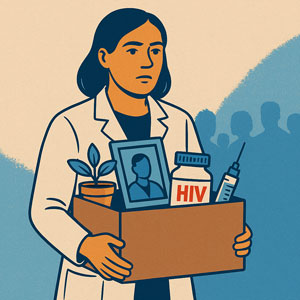
“We cannot do the complex and serious work of protecting Americans from infectious diseases amid this chaos and confusion,” Dr. Tan said in a statement. “The elimination of large swaths of highly trained and dedicated employees at HHS and throughout the agencies it oversees, including the National Institutes of Health, the Centers for Disease Control and Prevention, the Food and Drug Administration and other offices responsible for protecting America’s health is counter to the goal of keeping Americans healthy,” she added.
On April 1, HHS alerted federal employees by email beginning around 5 a.m. that they were being furloughed; many employees were not aware they were part of the “reduction-in-force” notices until their identification cards were deactivated, and they could not enter their building or check their work emails, according to several reports.
Last week, the administration said it planned to cut:
- 3,500 full-time employees at the FDA;
- 2,400 workers from the CDC;
- 1,200 from the National Institutes of Health; and
- 300 from the Centers for Medicare & Medicaid Services.
HHS said its dramatic restructuring would save taxpayers $1.8 billion by reducing the workforce of about 10,000 full-time employees. “When combined with HHS’ other efforts, including early retirement and Fork in the Road, the restructuring results in a total downsizing from 82,000 to 62,000 full-time employees,” HHS said in a statement.
The restructuring plan would consolidate the 28 divisions into 15 new divisions, including a new Administration for a Healthy America, as well as reduce regional offices from 10 to five. In addition, the HHS said it wanted to focus on chronic diseases.
“The overhaul will implement the new HHS priority of ending America’s epidemic of chronic illness by focusing on safe, wholesome food, clean water, and the elimination of environmental toxins. These priorities will be reflected in the reorganization of HHS,” HHS said in the statement.
However, many public health experts said HHS already focuses on chronic diseases, but still managed to also address infectious diseases and acute problems, such as the rising measles outbreak and opioid epidemic. In fact, the NIH has institutes dedicated to diabetes, kidney, heart and lung, and musculoskeletal diseases, drug abuse, inherited craniofacial diseases, deafness, child health and development, and aging, to name a few, and the CDC has centers that address birth defects and workplace safety, and it operates the National Center for Chronic Disease Prevention and Health Promotion, as well as various centers dedicated to prevent and respond to infectious diseases.
Public health is not an either-or proposition, experts have said.
“The cuts to CDC in particular in the HHS workforce have been unprecedented. They are completely out of step with history and best practices,” said Sharon Gilmartin, MPH, the executive director of the Safe States Alliance, a nonprofit organization and professional association dedicated to preventing injury and violence, a chronic problem in the United States affecting millions of Americans.
“HHS declared that its mission is to make Americans healthy again. How can we do that when the people who have spent decades of their lives combating the most pervasive health issues in the nation are being kicked out with no notice? The very issues that our administration claims to prioritize are now left without anyone to actually work on them,” Ms. Gilmartin said at a media briefing, sponsored by the Big Cities Health Coalition (BCHC).
Not only are federal workers being lost, but many work with state and local public health officials who will also lose their jobs as a result, she predicted.
“We don’t know what will happen with their portfolio of programs that support our state and local health departments across the country,” Ms. Gilmartin said.
Chrissy Giuliano, MPP, the executive director of the BCHC, a forum for the leaders of America’s largest metropolitan public health departments, which serve nearly 1 in 5 Americans, debated whether this reorganization would save money or be efficient. “It appears to be fairly haphazard,” she said. “There was not any time to transition work for staff who are working on measles, or lead poisonings, and all of the things that public health [does] in addition to infectious diseases.”
She said highly skilled subject-matter expertise will be lost. “The knowledge that sits at these federal agencies that provides guidance to state and local partners across the country is critical,” Ms. Giuliano said. “The money that supports this work and these workers was appropriated by Congress for specific programmatic activities. What are they going to support [now]? And what happens when that work doesn’t get done?”
Phil Huang, MD, MPH, the director of Dallas County Health and Human Services, said his organization recently received notice that three of its CDC grants were terminated. This resulted in 11 full-time and 10 part-time staff being terminated. These were local jobs, not federal ones, he reminded. “These staff that work in our epidemiology group respond to outbreaks, including the measles situation. They made sure that we don’t [see the spread of measles] or we don’t have a situation like is being seen in West Texas,” Dr. Huang said. As a result, more than 50 different immunization outbreak events in the community were canceled.
These cuts also will affect Dallas’ ability to test for COVID-19, measles and other diseases, he said, adding he was concerned “the lack of support being available to us from CDC, that technical expertise is really what we rely on the ground.
“I’m also hearing about impacts on HIV,” he said. “HIV prevention was one of the most cost-effective things that we were doing,” Dr. Huang said. “One new case of HIV leads to about $420,000 of lifetime treatment costs. You multiply that for every new case that we get as a result of the lack of prevention support, it is going to have a huge impact on us at the local level.”
At another briefing, sponsored by IDSA specifically about the HIV funding cuts, Anna K. Parson, MD, the vice chair of the HIV Medicine Association, and a professor of medicine in the Department of Infectious Diseases at Vanderbilt University Medical Center, in Nashville, Tenn., said four decades of HIV research and prevention efforts are at risk. “It is hard to overstate how challenging and chaotic this time has been for people living with HIV and for those who care for them. Through four decades of hard-fought progress, we have reached the point where HIV can now be a chronic disease.”
She said the United States has seen a 20% reduction in new HIV infections since 2010, but that is in jeopardy. “It has been estimated that the elimination of the CDC Division of HIV funding would lead to 143,000 new HIV infections and 14,000 AIDS-related deaths by 2030 at an additional cost of $60 billion,” Dr. Parson said, citing data from amfAR, The Foundation for AIDS Research, one of the world’s leading nonprofit organizations dedicated to the support of AIDS research, HIV prevention, treatment education, and advocacy.
“Tennessee has gone down this path before of cutting HIV prevention services,” she added. “In 2023, our governor rejected $8.3 million already allocated and budgeted funds for HIV prevention and treatment. As a result, many local long-standing organizations were affected, particularly in Shelby County, home to Memphis, one of the hardest-hit counties in the U.S. in terms of HIV.”
On April 2, more than 100 of the nation’s most respected public health leaders—including former secretaries of HHS, a former U.S. Surgeon General, multiple former CDC directors, former governors, and retired state health directors and commissioners of health, as well as corporate and nonprofit leaders—issued an open letter urging Congress to stop the administration’s sweeping efforts to dismantle the CDC and “undermine the country’s public health infrastructure.”
The signatories spanned political administrations, having served under former presidents Jimmy Carter, Bill Clinton, George W. Bush, Joe Biden and the first Trump administration.
The letter called on Congress to:
- hold immediate oversight hearings on the restructuring of the CDC and other HHS agencies;
- reinstate critical funding for public health programs, including funding for state, local and tribal public health departments;
- strengthen vaccination efforts and counter misinformation; and
- protect evidence-based public health programs, including those addressing chronic diseases, injury control and environmental threats.
In addition, researchers, along with the American Public Health Association; the International Union; United Automobile, Aerospace and Agricultural Implement Workers of America; and Ibis Reproductive Health filed a lawsuit challenging the abrupt cancellation of NIH grants.
“Ending these NIH grants wastes taxpayer money and years of hard work to answer the world’s most pressing biomedical questions. This is an attack on scientific progress itself,” said plaintiff Brittany Charlton, MD, an associate professor at Harvard T.H. Chan School of Public Health, in Boston. “Important discoveries and treatments will be delayed, putting lives at risk. Health issues in one community affect everyone, so this concerns us all.”
Of note, HHS Secretary Robert F. Kennedy Jr. said some of the cuts were done in error, and those people would be reinstated. However, it was unclear who would be reinstated or what functions HHS’s various departments would retain.
Sens. Bill Cassidy, MD, (R-La.), the chair of the Senate Health, Education, Labor and Pensions (HELP) Committee, and Bernie Sanders (I-Vt.), ranking member of the HELP committee, sent a letter to Mr. Kennedy inviting him to participate in a HELP Committee hearing on the reorganization of HHS. When he voted to confirm Mr. Kennedy, Mr. Cassidy said Mr. Kennedy would discuss changes at HHS before taking action and would meet with the HELP Committee quarterly, scheduled for April 10.
“We are following up on the commitment you made during the confirmation process that as Secretary you would come before the HELP Committee on a quarterly basis, upon request of the Chair,” they wrote.
“Over time, bureaucracies like HHS become wasteful and inefficient even when most of their staff are dedicated and competent civil servants,” Mr. Kennedy said in the HHS statement. “This overhaul will be a win-win for taxpayers and for those that HHS serves. That’s the entire American public, because our goal is to Make America Healthy Again.”
However, Mr. Sanders called the cuts reckless. “Let’s be clear: Arbitrarily firing over 10,000 workers at the Department of Health and Human Services will not make Americans healthier. It will make Americans sicker and less secure.
“At a time when the cost of health insurance and prescription drugs is soaring, these outrageous cuts will make it more difficult for seniors to receive the health care they desperately need. At a time when over 60,000 Americans die because they can’t afford to go to a doctor, these cuts will make it more difficult for 32 million Americans to get the primary care they need at community health centers all over our country. At a time when the cost of child care is out of reach for millions of American families, these cuts will make a bad situation even worse,” he wrote.