





Bats infected with rabies have surpassed racoons as the leading cause of rabies deaths among people in the United States, while rabid dogs that Americans encounter overseas are now the second-leading cause of rabies fatalities, the CDC announced (MMWR Morb Mortal Wkly Rep 2019;68[23]:524-528).
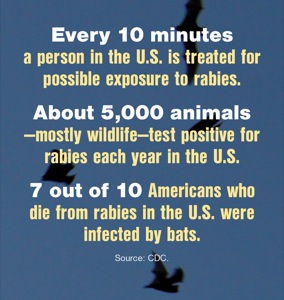
Although the overall bat population in the United States is declining, bats are responsible for approximately seven in 10 rabies deaths in this country, according to the CDC.
Among the roughly 5,000 rabid animals detected in the United States in 2017, 32% were bats, 28% were racoons, 21% were skunks, 7% were foxes, 6% were cats and only 1% were dogs, said Anne Schuchat, MD (RADM, USPHS), the CDC principal deputy director. “Starting in 2015, the number of rabid bats reported surpassed the number of racoons for the first time, and the gap has been widening ever since,” she said.
The decline in rabid racoons is due to an extensive oral vaccination campaign by the Department of Agriculture, “which has done an outstanding job of vaccinating racoons on the East Coast to prevent their spread westward,” said Emily Pieracci, DVM, MPH, a veterinarian in the CDC’s Rabies Branch. Although no oral vaccine exists for bats, several institutions are trying to develop one, she said.

Increasing Public Awareness
The CDC advised anyone who comes in close contact with a bat to immediately seek medical attention to receive post-exposure prophylaxis (PEP). “People may not realize that bats carry rabies, so they may not see their medical provider after touching or handling a bat,” Schuchat said. “The danger is that many people don’t even realize they have been bitten. Bat bites are small, smaller than a pencil eraser.”
Rabies is 100% preventable as long as people receive PEP, which combines rabies vaccine and rabies immune globulin to prevent infection after exposure to the virus. However, it must be given before symptoms appear.
That means health care providers should question patients about their exposure if they have come in contact with bats in the United States or with dogs while traveling abroad in countries where rabies is prevalent. If they have been bitten or scratched, Dr. Pieracci said, “the safest course of action is to give PEP so we are sure the person is protected even if the provider does not know if the animal was infected.
“While the majority of bats in the wild do not carry rabies, you cannot tell which bats have rabies just by looking at them,” Dr. Pieracci said. “The problem comes when people try to handle bats they think are healthy. The best advice is to avoid contact with bats—and other wildlife.”
Post-Exposure Prophylaxis
The Advisory Committee on Immunization Practices (ACIP) recommends “that prophylaxis for the prevention of rabies in humans exposed to rabies virus should include prompt and thorough wound cleansing followed by passive rabies immunization with human rabies immune globulin (HRIG) and vaccination with a cell culture rabies vaccine.
“For persons who have never been vaccinated against rabies, postexposure antirabies vaccination should always include administration of both passive antibody (HRIG) and vaccine (human diploid cell vaccine [HDCV] or purified chick embryo cell vaccine [PCECV]),” the ACIP recommended (MMWR Morb Mortal Wkly Rep 2008/57[RR03];1-26,28). People who have received complete PEP previously should receive only two doses of vaccine, according to the ACIP.
Even though bats are shy by nature, urban and suburban development has encroached on their habitats, so there are increasing encounters between humans and bats. Although less than 1% of bats in the wild are rabid, there is a greater chance that bats encountered in a building are rabid, because a “normal” bat would try to get outside, said Rodney Willoughby, MD, a professor in Pediatrics (Infectious Diseases) at Medical College of Wisconsin/Children’s Hospital of Wisconsin in Milwaukee, who in 2004 developed a protocol used to treat the first person to survive the disease without having PEP (N Engl J Med 2005;352[24]:2508-2514).
If there is a bat in a dwelling, the proper authorities should be contacted to capture it for rabies testing. “Testing [results] can come back in a couple of days and you can actually wait until that testing is complete,” he said, terming it an urgency, not an emergency, which is what the ACIP recommends: “To appropriately manage potential human exposures to rabies, the risk for infection must be accurately assessed. Administration of rabies postexposure prophylaxis is a medical urgency, not a medical emergency, but decisions must not be delayed.”
If the test comes back positive for rabies, “start your post-exposure prophylaxis,” Dr. Willoughby said. “The incubation period for rabies is remarkably long and variable. It’s longer than the time needed to generate an immune response to a vaccine. That gives you time to go see your physician.”
Dr. Willoughby said there are about six fatal cases of rabies per year in the United States, of which half originate overseas. Since its development in 2004 to treat patients who developed rabies, the Milwaukee Protocol has saved the lives of 18 people infected with rabies, for a 20% rate of effectiveness, he said. Up to that point, the 2004 patient had been the only one to survive without PEP.
Dr. Willoughby said the Milwaukee Protocol has been revised and updated based on new data accumulated from additional cases, with version 6 released in November 2018 (bit.ly/2jX6tzL). He is optimistic that the 20% survival rate could eventually increase to 50%.
Mass Bat Exposures
Another problem with the urbanization of the bat population is the exposure of multiple people. “Mass bat exposures,” in which 10 people or more were exposed to a bat in a single location, such as in attics, under bridges or in campgrounds, are becoming more of a problem, according to the CDC. There have been 175 mass exposures per year since the CDC started tracking them in 2015, with an average of 3.5 incidents in each of the 49 states (excluding Hawaii) where rabid bats have been found, the CDC said.
Mass bat exposures are a challenge. Since the incubation period for rabies generally is months, the CDC and local health officials must backtrack to locate individuals who were in the building or the area where bats congregate “to make sure everyone who needs PEP gets it. Investigations are quite extensive and take quite a long time and require quite a lot of manpower,” Dr. Pieracci explained, adding that bats have been in some dwellings for months if not years.
She cited a case in which bats congregated in the attic of an Indiana college sorority house. The bats had been routinely sighted in shared living areas and “a number of students were trying to catch the bats with their bare hands.” Because 4.3% of all bats tested in the state were positive for rabies virus, there was cause for concern. A total of 140 students and eight employees were interviewed and four were recommended to receive PEP (MMWR Morb Mortal Wkly Rep 2018;67[5]:166).
Dramatic Shift in Exposures
During the past 81 years, the landscape of rabies in the United States has shifted dramatically, Dr. Schuchat said.
Before 1960, bites from rabid dogs caused most human rabies cases in this country, but with mass pet vaccination programs and leash laws enacted in the 1950s, dogs now comprise only 1% of rabid animals reported each year. In contrast, cats have not fared as well. Since the 1990s, three times more rabid cats have been reported in the United States as rabid dogs.
“Cats are now the leading transmitter of domestic rabies in the United States,” Dr. Willoughby said.
“Vaccinating cats is very important in case they have contact with wildlife inside or outside the home,” Dr. Schuchat said.
Rabid dogs can still be a problem overseas, according to Dr. Pieracci. Globally, they cause about 98% of the 59,000 human deaths from rabies each year. The CDC recommends travelers avoid animals (particularly puppies and kittens too young to vaccinate), have a plan to get care if are scratched or bitten, and have travel health insurance to pay for treatment should they need it. Some travelers may also want to consider preexposure vaccination depending on their travel plans. More information is available on the CDC’s Travel Health website.
Imported dogs also pose a risk. The CDC estimates that more than 1 million dogs enter the United States annually, and 107,000 are imported from countries where canine rabies is common.
Besides animal vaccination, education has greatly decreased human rabies in this country, they said. Today, one to three deaths from rabies occur each year in the United States, down from 50 per year before 1950. However, about 55,000 people in the United States seek PEP after a potential rabies exposure every year, according to Dr. Schuchat.
Drs. Schuchat, Pieracci and Willoughby reported no relevant financial relationships.