





Antimicrobial resistance (AMR) is everyone’s problem, according to Robert A. Bonomo, MD, who spoke at MAD-ID 2024, in Orlando, Fla. By 2050, growing AMR will be responsible for 300 million deaths globally, according to a report commissioned by the UK government (bit.ly/3VPwU8j). Those sobering numbers are why a strong pipeline for antimicrobial medications is needed.
“We all know that AMR is not getting any better,” said Dr. Bonomo, the senior associate dean and a distinguished university professor at Case Western Reserve University, as well as a clinical scientist investigator for Case VA Center for Antimicrobial Resistance and Epidemiology, in Cleveland.
One of the aspects of AMR that Dr. Bonomo said keeps him up at night is the increasing problem of beta-lactamase–mediated resistance. Out of six common forms of resistance, four are mediated by this enzyme: third-generation cephalosporin-resistant Escherichia coli, carbapenem-resistant Acinetobacter baumannii, carbapenem-resistant Klebsiella pneumoniae and E. coli, and multidrug-resistant Pseudomonas aeruginosa.
“I’m worried about our society, I’m worried about our world when it comes to AMR,” Dr. Bonomo said. “The hard data show an estimated 5 million deaths associated with AMR in 2019. What worries me the most is that the highest resistance rate will emerge in sub-Saharan Africa, at 27.3 deaths per 100,000 people.”
These deaths are “a political, economic, medical and social statement,” he explained, because this is not just a problem for Africa. Since unusual infections and rare resistant isolates from other countries cross borders into the United States, global issues become local concerns. AMR cannot be ignored, Dr. Bonomo said.

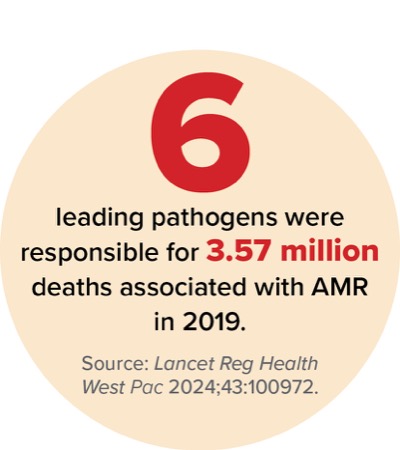
Resistant organisms dominate the major infections, including lower respiratory tract, bloodstream and intraabdominal. The six leading resistant pathogens associated with deaths are E. coli, K. pneumoniae and A. baumannii, Staphylococcus aureus, Streptococcus pneumoniae and Pseudomonas aeruginosa. These organisms were directly responsible for 929,000 deaths attributed to AMR and contributed to 3.57 million deaths in 2019, according to Dr. Bonomo, citing published data (Lancet Reg Health West Pac 2024;43:100972).
Despite the recent introduction of new antimicrobials, an adequate pipeline is also important because resistance will develop to all the newer entrants. Unfortunately, the time it takes for that to happen seems to be accelerating. “The old paradigm that you introduced the drug and then a couple of years later, you observed resistance in the clinic [is changing],” Dr. Bonomo noted. “It is only my opinion—the new timeline is that drug resistance has emerged already—when we introduce a new drug into the clinic, we are finding that resistance.”
He stressed that his concern is not limited to pipeline agents; it also extends to newer approved antibiotics, including ceftazidime-avibactam (Avycaz, AbbVie), imipenem-cilastatin-relebactam (Recarbrio, Merck), meropenem-vaborbactam (Vabomere, Melinta), ceftolozane-tazobactam (Zerbaxa, Merck) and cefiderocol (Fetroja, Shionogi).
Powerful Combination Therapies
A few new beta-lactam/beta-lactamase inhibitor combinations have entered the pipeline or were recently approved, which Dr. Bonomo described as powerful drugs:
- cefepime-taniborbactam (VenatoRx Pharmaceuticals/Melinta Therapeutics);
- cefepime-zidebactam (Wockhardt);
- sulbactam-durlobactam (sul-dur; Xacduro, Innoviva);
- cefepime-enmetazobactam (Exblifep, Allecra Therapeutics); and
- xeruborbactam (Shionogi).
Related Content


The combination of taniborbactam with cefepime looks very promising in laboratory studies and appears to have good tolerability and safety. In a phase 3 study among hospitalized adults with complicated urinary tract infections (cUTIs) who received IV cefepime-taniborbactam or meropenem every eight hours for seven days (with the possibility of a 14-day extension if needed), cefepime-taniborbactam was 70.6% effective in 207 of 293 patients, while meropenem was 58.0% effective in 83 of 143 patients.
Unfortunately, the FDA issued a complete response letter to VenatoRx and Melinta for its new drug application for cefepime-taniborbactam to treat cUTIs, but the companies have addressed the manufacturing issues that concerned the FDA, so the agency is reviewing the application again.
A novel product taking a similar approach is xeruborbactam, which when combined with ceftazidime, cefepime or meropenem, significantly decreased the minimum inhibitory concentrations of many metallo-beta-lactamases, including strains producing NDM, VIM, IMP, GIM-1 and DIM-1 enzymes.
Other Promising Entrants
Sul-Dur
“Durlobactam plus sulbactam is an interesting combination,” Dr. Bonomo said. Durlobactam protects sulbactam from degradation by the enzymes A. baumannii may produce, thereby inhibiting its ability to outwit the drug.
In 2023, the FDA approved sul-dur for hospital-acquired (HABP) and ventilator-associated bacterial pneumonia (VABP) caused by A. baumannii in adults. In a multicenter, active-controlled, open-label (investigator-unblinded, assessor-blinded), noninferiority clinical trial in 177 hospitalized adults with pneumonia caused by carbapenem-resistant A. baumannii (CRAB), patients received either sul-dur or colistin for up to 14 days. Both treatment arms also received an additional antibiotic, imipenem-cilastatin, as background therapy for potential HABP/VABP pathogens other than A. baumannii–calcoaceticus complex. The primary measure of efficacy was all-cause mortality within 28 days of treatment in patients with a confirmed infection with CRAB. Of patients who received sul-dur, 19% (12/63) died, compared with 32% (20/62) who received colistin, demonstrating noninferiority.
Sul-dur is the preferred agent to treat CRAB, Dr. Bonomo said, but he noted that strain differences could occur among Acinetobacter, so it’s important to watch the data as the product is used.
Look to PK/PD Data for Combating Resistance, Improving Stewardship
Antibiotics receiving FDA approval today have a significantly higher probability of hitting their pharmacokinetic/pharmacodynamic (PK/PD) targets than in earlier eras, according to Joseph L. Kuti, PharmD, the director of the Center for Anti-Infective Research and Development at Hartford Hospital, in Connecticut.
“Regulatory requirements now encourage preclinical PK/PD studies as IND [investigational new drug]-enabling trials, which leads to approved dosing regimens with higher likelihood of success. Package insert doses have high likelihood of success for susceptible pathogens,” said Dr. Kuti, who also spoke at MAD-ID 2024. “We have found that those preclinical studies agree very nicely with human studies and are quite predictive of what is going to happen in humans. When there are differences, we see that in humans, the free time above MIC [minimum inhibitory concentration] targets can vary quite significantly.”

Dr. Kuti pointed to a review of murine and clinical literature on beta-lactam PD thresholds that he published in 2022, which found that murine-based targets specific to each antibiotic are most useful during dosage regimen development and susceptibility breakpoint assessment, while a range of exposures between 50% and 100% fT greater than the minimum inhibitory concentration are reasonable to define the beta-lactam therapeutic drug monitoring (TDM) window for most infections (Front Pharmacol 2022;13:833189; bit.ly/3LWHCpb-IDSE).
International consensus recommendations published in 2023 now recommend prolonged-infusion beta-lactam antibiotics over standard infusion to reduce mortality or increase clinical cure in severely ill adult patients, particularly those with gram-negative infections.
“It’s the first review to pull all the existing data together on prolonged beta-lactams, and the panel voted 17 to 0 in favor of this recommendation,” Dr. Kuti noted, although he acknowledged that most of the data they reviewed were for older antibiotics that were optimized to be given in a prolonged infusion. “There is little downside to basing these recommendations on good PK/PD science.”
Beta-lactam TDM remains rarely available, he added. In a 2022 survey of U.S. hospital infectious disease residency program directors, only three of 39 respondents (8%) indicated that their program had beta-lactam TDM (Am J Health Syst Pharm 2022;79[15]:1273-1280; bit.ly/3WXKp6P-IDSE). That’s despite enthusiasm for the practice. In a study conducted at academic medical centers with varying degrees of beta-lactam TDM implementation, most of the 138 survey respondents perceived that monitoring was relevant to their practice and improved medication effectiveness and safety. “To improve adoption, we really need a comprehensive guidance document about how to do this, which I am happy to say is in the works,” Dr. Kuti said. “Hopefully by 2025, we will have some published recommendations on beta-lactam TDM.”
Area under the curve (AUC)-based dosing for vancomycin continues to demonstrate efficacy, Dr. Kuti said. “Not only that, but the toxicodynamics are significantly improved. Because of [pharmacokinetics/pharmacodynamics], our day-to-day responsibilities with vancomycin have improved and our patient outcomes are better.”
Cefepime-enmetazobactam
The FDA approved cefepime-enmetazobactam for the treatment of cUTIs, including pyelonephritis, in February. Approval was supported by clinical data demonstrating that cefepime-enmetazobactam was effective against extended-spectrum beta-lactamases (ESBLs) and AmpC. Results from the phase 3 ALLIUM trial showed that the proportion of patients infected with gram-negative pathogens who achieved clinical cure and microbiological eradication was 79.1% with cefepime-enmetazobactam, compared with 58.9% of patients treated with piperacillin-tazobactam. According to the investigators, that difference met the prespecified noninferiority margin of –10% as well as the prespecified criterion for superiority in favor of cefepime/enmetazobactam (JAMA 2022;328[13]: 1304-1314).
Zidebactam
Zidebactam is a bicyclo-acyl hydrazide beta-lactam enhancer being developed for gram-negative infections and is “a novel inhibitor to watch,” Dr. Bonomo said. The antibiotic appears highly active against Enterobacterales and P. aeruginosa, has good activity against Stenotrophomonas maltophilia and Burkholderia cepacia, and retains activity against carbapenem-resistant isolates of Acinetobacter species, he noted (J Antimicrob Chemother 2022;77[10]:2642-2649).
Gepotidacin
Gepotidacin (GlaxoSmithKline) is a first-in-class triazaacenaphthylene antibiotic that inhibits bacterial DNA replication by blocking two essential topoisomerase enzymes. Gepotidacin is noteworthy because mutations in both enzymes would likely be necessary for resistance to occur, Dr. Bonomo said, so developers hope this medication will maintain long-term effectiveness.
Zosurabalpin
A new and interesting drug to consider because of its activity against Acinetobacter is zosurabalpin (RG6006, Roche). This drug effectively treated highly drug-resistant contemporary isolates of CRAB both in vitro and in mouse models of infection, overcoming existing antibiotic resistance mechanisms (Nature 2024;625[7995]:566-571). This novel class (tethered macrocyclic peptide) blocks the transport of bacterial lipopolysaccharide from the inner membrane to its destination on the outer membrane. “Pending clinical trials to validate its effectiveness, pharmacokinetics, and resistance management, [zosurabalpin’s] preclinical success suggests a substantial shift in treating antibiotic resistance,” Que et al recently commented (Trends Mol Med 2024;30[5]:420-422).
Dr. Bonomo reported research grants from Allecra, Merck and Wockhardt within the past three years.
This article is from the August 2024 print issue.