





The HIV and opioid epidemics are intrinsically entwined. People who are using opioids—especially those who inject drugs—are at increased risk for HIV, and one epidemic could undo strides made against the other, experts said.
“Any uptake in injection drug use is likely to lead to more HIV cases,” explained Ricky N. Bluthenthal, PhD, the associate dean for social justice and a professor in the Department of Preventive Medicine at the University of Southern California’s Keck School of Medicine, in Los Angeles.
For instance, an HIV transmission cluster was found in Scott County, Ind., where 181 people were diagnosed with HIV from Nov. 18, 2014 to Nov. 1, 2015, 87.8% of whom reported injecting oxymorphone. Nearly 93% of the patients were coinfected with hepatitis C virus (HCV) (N Engl J Med 2016;375[3]:229-239).
Clusters like these highlight the risks for reversing the progress made in preventing the spread of HIV, according to Jen Kates, PhD, the vice president and director of Global Health and HIV Policy at the Kaiser Family Foundation in Washington, D.C.

“While the share of HIV infections associated with injection drug use has declined dramatically since the beginning of the HIV epidemic—which is a major success in the fight against HIV—the 2015 outbreak drove an increase,” she said. “This highlights the intersection of the two epidemics and the fragility of success, particularly in the absence of access to syringe exchange and other prevention services that can curb transmission.”
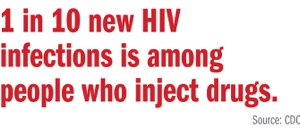
According to UNAIDS, about 12.7 million people inject drugs worldwide, and more than 10% are also living with HIV.
“Injection drug use was a significant contributor to HIV transmission in the U.S. in the 1980s and early 1990s,” said Bluthenthal, so it stands to reason that it would continue to be a risk factor with the opioid epidemic (Drug Alcohol Depend 2018;185:253-259).
“We are likely to have more cases of HIV due to drug injection, and these cases are likely to occur in areas such as rural communities with inadequate HIV prevention services and HIV care services,” he said.
An Intertwined ‘Syndemic’
“The opioid and HIV epidemics are unassailably intertwined into a ‘syndemic’,” agreed Nabila El-Bassel, PhD, a professor at the Columbia University School of Social Work, in New York City. “The availability of opioids is ubiquitous, both through misuse of prescribed opioid pharmaceuticals and illicit drugs. This has led more individuals to inject and share needles and syringes; thus, more people have become infected with HIV.”
In many of the areas hardest hit, harm reduction programs such as needle exchange programs are scarce.
“The geographic spread of new people who inject drugs is an independent problem in and of itself,” Bluthenthal added. “Many regions hit with these increases missed the advent of syringe exchange programs that were implemented locally in major cities and regions. These programs are generally credited with the overall reductions in HIV transmission among people who inject drugs, particularly in the Northeast. The political will to implement this program in the face of poor federal support is modest, and several programs that were started have already been stopped in West Virginia and Indiana.” In addition, he said, the program models do not embrace best practices such as the delivery of safer injection supplies to participants, needle-exchange programs and extended hours.
Also, the emergence of fentanyl as a popular substitute for heroin is increasing injection-related risks due to its shorter half-life. “People who inject fentanyl inject eight or more times a day instead of the typical two to four times a heroin user might inject,” El-Bassel added. “By injecting more frequently, users of fentanyl have a greater likelihood of sharing needles/syringes. This behavior and others associated with HIV risks such as trading sex for drugs, money or a place to sleep all lead to new HIV infections.”
And a recent report from the National Institute of Drug Abuse found that methamphetamine use and deaths have also increased, especially among Native Americans and Alaska Natives. Many of the same infections seen in opioid abusers occur in methamphetamine users (JAMA Psychiatry 2021 Published online Jan. 20 DOI: 10.1001/jamapsychiatry.2020.4321). Methacillin-resistant Staphylcococcus aureus is also a problem (Frontiers in Neuroscience 2015;8:445 doi: 10.3389/fnins.2014.00445).
Unique Challenges
The characteristics of IV drug users often complicate treatment approaches, and provide a challenge for health care professionals attempting to address both HIV and drug abuse.
“Injection drug users tend not to be linked to substance abuse treatment or medical care and are unlikely to seek HIV testing,” El-Bassel said. “They become a community of individuals with unknown HIV status whose drug using and sexual behaviors are capable of turning them into a vector and transmitting the HIV virus to others.”
This, according to Bluthenthal, increases the importance of quickly getting these individuals appropriate treatment. “Rapid implementation of medication treatment, such as buprenorphine, methadone and naltrexone, is needed to both prevent HIV spread and assist with engagement in HIV treatment,” he said.
Equally important is managing factors that may make adherence to HIV therapy harder for patients abusing opioids. “It is in patients’ best interests that providers work with them to increase antiretroviral therapy (ART) adherence, as well as adjust therapeutic doses to improve HIV-related outcomes,” El-Bassel commented. “Opioid use should not be considered a contraindication to ART.”
Medications for opioid use disorder (MOUD), such as buprenorphine and naltrexone, have been shown to improve adherence to ART and increase viral suppression (Curr HIV/AIDS Rep 2019;16[1]:1-6). “Strategies that integrate MOUD into HIV care are critical to achieving HIV viral suppression among patients living with HIV and opioid use disorder,” El-Bassel said.
And the nature of addiction itself may change the way patients approach adherence. “When individuals have co-occurring HIV and an addiction to substances, such as opioids or methamphetamine, nothing else matters but the drug,” said Susanne Astrab Fogger, DNP, a professor in the School of Nursing at the University of Alabama at Birmingham. “Their brain has been hijacked, with the drug being the priority. Medication adherence, which is vital to viral suppression, is lost in the addiction.”
A Governmental Failing and Need for Response
For some experts, the greatest failing has been in the government’s response to the threat. “I lament this country’s failure to fully understand and integrate the management of HIV care and drug treatment into primary care for people with HIV and opioid use disorders,” El-Bassel said. “Injection drug users who are living with HIV have very limited access to opioid use treatment. Attempting to retain patients with opioid use disorders who are not receiving opioid treatment combined with their HIV care remains serious, and needs attention.”
El-Bassel noted that “the opioid and HIV syndemic share major structural drivers such as poverty, economic inequities, health disparities, a lack of integrations of services, and a market-driven health care system with poor access to health care insurance, and a lack of rules and regulations for pharmaceutical market placement.
“Each of these drivers limits access to drug treatment, HIV services and care, and continue to heighten the spread of the syndemic,” she said.
Appropriately addressing these challenges will require programs designed with the intersection of opioid abuse and infectious diseases in mind.
“To ultimately reduce HIV transmissions and opioid use disorders, the U.S. health care system, and the government programs that finance it, need to have a major paradigm shift to address both of these comorbidities, at the same time with a comprehensive assessment of the individual patient’s treatment needs, and provide treatment for the comorbidities through accessible integrated community-based medical and drug treatment services,” El-Bassel added.
The sources reported no relevant financial disclosures.

This article is from the March 2021 print issue.