





Related Content


U.S. institutional responses to the 2022 mpox outbreak were highly variable, with testing access, result turnaround time, and communication cited as the most significant challenges in a survey of infectious disease specialists and infection prevention leaders conducted through the Society for Healthcare Epidemiology of America Research Network.
The study (abstract P-573) was presented at IDWeek 2025, in Atlanta, by Jordan Beam, BS, and Rachael Cowan, BS, medical students at the University of Alabama at Birmingham Heersink School of Medicine. It assessed how hospitals and health systems managed the first mpox outbreak to affect nonendemic countries on a broad scale. By May 2023, more than 80,000 cases and 140 deaths had been reported from 111 countries, with a disproportionate impact on men who have sex with men (MSM).
Testing, Results Delays Were Biggest Obstacles
Between December 2024 and April 2025, investigators distributed a cross-sectional survey to infectious disease specialists and infection preventionists at hospitals across the United States and Canada. Of the 38 institutions that responded, most represented large teaching hospitals and academic centers.
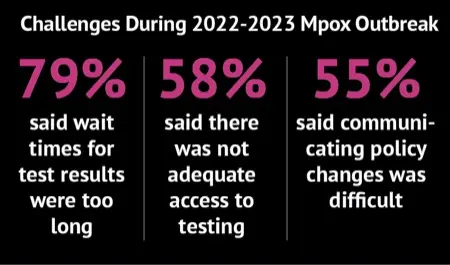
“The overwhelming issue we saw reported was with testing, both access to testing and the wait time for results,” Beam said. Many respondents described delays of several days to a week before results were available. Communicating policy changes was another major obstacle, as recommendations evolved rapidly. To address this, institutions enhanced internal communication within care teams and strengthened coordination with public health departments.

While resource limitations were not universal, institutions in the southern United States were more likely to report shortages of staff or materials. More than 80% of respondents said their institutions’ mpox responses were at least moderately shaped by lessons learned from COVID-19, such as faster mobilization of infection-control teams and more agile outbreak protocols.
One Step Forward, Two Steps Back
The results underscore both progress and fragility in public health preparedness, said Boghuma Titanji, MD, PhD, MSc, DTM&H, an assistant professor of medicine in the Division of Infectious Diseases at Emory University School of Medicine, in Atlanta, who was not involved with the study. “Turnaround time for testing and access to testing posed challenges for much of the outbreak,” she said. “In 2022, before many healthcare systems had in-house testing, samples were sent to state labs or the CDC, and results could take seven to 10 days. That made it very difficult to trace contacts and contain spread.”
Dr. Titanji cautioned that today’s environment may be even less equipped to respond effectively. “We’ve seen further cuts in public health infrastructure at the federal and state levels since 2022. If faced with an outbreak of mpox or another emerging infection now, health systems might struggle even more to respond,” she said.
Still, she noted, the survey identified promising mitigation strategies: improved communication channels between departments, stronger relationships with local and state public health authorities, and rapid adaptation of existing outbreak protocols. “There was a degree of resilience but sustaining that will require continued investment in the systems that support it,” she said.
Cowan also looked toward the future. “We believe recognizing both the effective strategies and areas of weakness from this outbreak is essential to refining and strengthening future public health responses,” she said.
The sources reported no relevant financial disclosures.
This article is from the February 2026 print issue.