





Individuals with HIV face a higher risk for deaths, suicide and depression, the latter of which often goes untreated, according to findings from four studies presented at CROI 2024, held in Denver. People living with the disease already face a higher burden of comorbidities, especially cardiovascular diseases, cancer, diabetes and kidney disease.
“Individuals living with HIV face additional challenges with comorbidities because HIV can lead to chronic inflammation, which can accelerate aging,” said Karena Volesky-Avellaneda, PhD, a postdoctoral fellow in the National Cancer Institute’s Infections and Immunoepidemiology Branch. “Immune dysfunction associated with HIV makes it difficult to control infection and disease, and they are more likely to have coinfections such as hepatitis B and C, which can worsen comorbidities, and finally people with HIV can face barriers to accessing healthcare that can delay the diagnosis and treatment of comorbidities.”
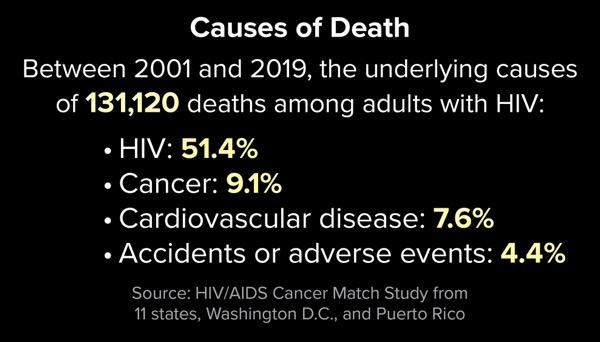
Dr. Volesky-Avellaneda was the lead author on a study that evaluated the underlying causes of death among people with HIV who were 20 years of age and older and died between 2001 and 2019. The data were obtained from registries in the HIV/AIDS Cancer Match Study that captured this information from 11 states, Washington, D.C., and Puerto Rico. Among the 131,120 deaths, 51.4% were caused by HIV; 9.1% by cancer; 7.6% from cardiovascular disease; and 4.4% by accidents or adverse events (abstract 1054).
“I was surprised that while the overall risk for death among people with HIV is 4.4 times higher than the general population overall, this risk greatly varied by group,” Dr. Volesky-Avellaneda said. “For example, compared with the general U.S. population, people with HIV ages 20 to 39 were at 9.2 times higher risk for death, females living with HIV who inject drugs were at 11 times higher risk for death, and non-Hispanic Black people with HIV were at 15.8 times higher risk for death.”
The findings were similar to another study that analyzed death certificate data from California Vital Statistics between 2018 and 2021. Overall, age-adjusted mortality rates (AAMRs) rose by 14.6% with the largest increases in non-white populations (abstract 1055). AAMRs also decreased by 7.9% for white and 0.2% for Latinx individuals with HIV, but increased 13.9% for multiracial, 9.0% for Asian and 4.8% for Black people living with HIV.

“While we expected the emergence of COVID-19 to impact the death rate, the other surprising finding was the extent that deaths from drug overdose had increased. Drug overdose AAMR increased 63.7% from 2018-19 to 2020-21. AAMR among Black [84.1.%], multiracial [83.1%] and Latinx [77.4%] people with HIV increased more than white [41.7%] individuals,” said Darpun Sachdev, MD, the lead author of the study and the chief of the COVID Control Branch in the Division of Communicable Disease Control with the California Department of Public Health (CDPH).
Dr. Sachdev said the CDPH supports several initiatives to help people living with HIV in California, including Project Cornerstone and Project Empowerment. The former funds innovative, evidence-informed approaches to improve the health and well-being of older patients with HIV, while the latter does the same in both Black and Latinx communities.
Depressing News
Studies also have shown that people with HIV are disproportionately affected by depression. They experience poorer social determinants of health and socioeconomic status compared with the total U.S. population.
“Many people with HIV have experienced trauma, in addition to having to deal with the stress of living with a chronic and often stigmatized disease,” said Linda Beer, PhD, an epidemiologist in the CDC’s Division of HIV Prevention.
Dr. Beer was the lead author on a study that used data collected between June 2021 and May 2022 from 3,298 adults with HIV from the CDC Medical Monitoring Project (MMP) to report nationally representative estimates of depression among U.S. adults with HIV (abstract 00178). The MMP is a national surveillance system that uses a probability sample to produce annual, cross-sectional estimates of behavioral and clinical characteristics of people with HIV.
Researchers found that one in every three people with HIV in the United States experienced depression. Of those with depression, nearly half had undiagnosed depression or experienced considerable depressive symptoms. Certain groups, including transgender women and people with food insecurity, were more affected by depression than others.
“It was disheartening to find that over one out of every four people with HIV who experienced depression had undiagnosed depression and were not receiving the potential benefits of treatment,” Dr. Beer said. “Also, the association of depressive symptoms with poor social determinants of health—such as food and housing insecurity, unemployment and healthcare discrimination—highlights the need to address multiple factors that affect the health and well-being of people with HIV.”
Dr. Beer said providing routine and repeated mental health screening is the first step toward delivering treatment options that can improve health and quality of life.
“Given the strong relationship between self-reported disabilities and depression, connecting people to programs that can help manage disabilities and other health conditions could be helpful,” she said.
Feeling Suicidal
In addition to depression, people with HIV have an increased risk for suicidality, which includes suicidal ideation, plans and attempts. To assess trends in emergency department visits in the context of suicide, researchers used the Einstein-Rockefeller-CUNY Center for AIDS Research HIV Clinical Cohort Database to identify all emergency department visits among patients ages 17 years and older in the Montefiore Health System between 2016 and 2022 (abstract 1051). Suicide-related visits were determined by using ICD-10 diagnosis codes for suicidal ideation and behavior.
Researchers found that suicide-related visits were nearly three times higher among people with HIV compared with those without it. The highest rates of suicide-related emergency department visits were among people between the ages of 17 and 39, cisgender men, non-cisgender individuals, people with a history of injection drug use and those with unsuppressed viral loads.
“More research into associated factors is needed to help inform suicide-preventive approaches in [people with HIV],” the authors wrote.
The sources reported no relevant financial disclosures.

This article is from the June 2024 print issue.