





A Colorado measles outbreak last spring demonstrates how quickly a single infectious traveler can spark multiple secondary cases, including infections in vaccinated people after intense exposure, according to a newly published report (MMWR Morb Mortal Wkly Rep 2026;75[4]:48-54).

What Happened?
From May 25 through June 7, 2025, investigators identified nine secondary measles cases and one tertiary case among Colorado residents linked to an infectious traveler who passed through Denver following an international flight. Seven additional cases were reported in other jurisdictions.
The index patient was an unvaccinated non-Colorado resident who had acquired measles in the United States, traveled internationally, and then returned through Denver International Airport while infectious. Colorado investigators found that four secondary cases occurred among passengers on the same international flight, and five others were linked to exposure in the Denver airport terminal or concourse.
Related Content


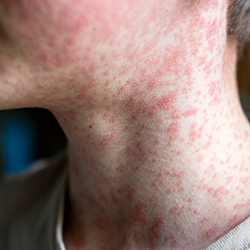
Four of the nine secondary Colorado cases occurred in people who had received two doses of measles, mumps, and rubella (MMR) vaccine prior to exposure.
Outbreaks Remain a Risk, Even to the Vaccinated
Lead author Amanda Metz, MPH, said the report reinforces that traveler-related measles outbreaks remain a real risk, even if the risk for transmission in locations such as airports and on airplanes is rare.
“While secondary measles cases in places like airplanes and airports are uncommon, measles is very infectious and can quickly spread, especially among people who are unvaccinated,” she said. “In this situation, a large number of cases were linked to a single infectious traveler with measles, including four breakthrough cases among Colorado residents. Breakthrough cases are rare but can occur following intense and prolonged exposure.”
Maybe Try Incorporating Urine Testing
The report also highlights a diagnostic point that may help improve case finding. In two vaccinated patients, measles virus was detected only in urine and not in nasopharyngeal specimens, and in another patient with unknown vaccination status, urine polymerase chain reaction remained positive 24 days after rash onset. The authors of the report noted that collecting urine specimens may improve detection, especially in vaccinated people with milder or modified illness.
The Importance of Vaccination
Among the Colorado secondary cases, vaccinated patients had fewer and milder symptoms, whereas three unvaccinated patients and one patient with unknown vaccination status were hospitalized. All individuals recovered. Public health officials identified approximately 1,400 contacts in Colorado during the response.
Metz said the outbreak also underscores the importance of prevention.
“The outbreak underscores the need for up-to-date MMR vaccination before travel,” she said. “With ongoing measles outbreaks in the U.S. and abroad, travelers should ensure that they are fully vaccinated.”
Metz reported no relevant financial disclosures.