


By Ethan Covey
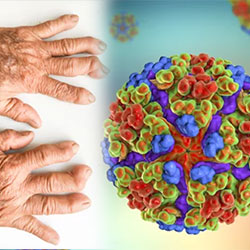
A significant proportion of patients with chikungunya fever develop rheumatoid arthritis (RA) following infection with the chikungunya virus, according to a recently published meta-analysis.
The study is believed to be the first to investigate the relationship between chikungunya virus infection and the subsequent development of RA (Trop Med Infect Dis 2025;10[2]:54. doi:10.3390/tropicalmed10020054).
“I have always been struck by the impact of chikungunya fever on people’s health, especially the high number of patients who continue to experience joint pain and inflammation for months or even years after infection,” said the lead author of the report, José Kennedy Amaral, MD, a doctor in the Postgraduate Program in Health Sciences and faculty of medicine at Federal University of Cariri, in Ceará, Brazil. “As a rheumatologist, I often see cases where post-viral arthritis closely resembles rheumatoid arthritis, but there was a lack of comprehensive analysis on this connection.
“Our study helps fill that gap,” Dr. Amaral said.
The review included data from literature searches of multiple databases through Sept. 3, 2024. Ultimately, 16 studies with a total of 2,879 patients were included. Among these individuals with chikungunya virus infection, approximately 13.7% later developed RA. Among studies the researchers deemed to be of higher quality—cohort studies classed as having low risk for bias—the percentage of people with chikungunya virus infection who developed RA was 17.7%.
“These findings are highly relevant because they reinforce the need for long-term rheumatologic follow-up in these patients and raise important questions about whether chikungunya virus may act as a trigger for autoimmune diseases,” Dr. Amaral said.
However, Dr. Amaral and his co-authors noted that a high level of heterogeneity between the studies suggests that “factors such as differences in diagnostic criteria, study populations and follow-up durations may have influenced the results.”
What Kind of Arthritis?
Further complicating the issue, a question remains regarding whether chikungunya virus infection actually increases the risk of developing RA, or if some individuals with chronic chikungunya arthritis (CCA) present as RA mimics.
“This is the question that many doctors and researchers are trying to answer,” Dr. Amaral told Infectious Disease Special Edition. “Our study shows that in some cases, CCA can be indistinguishable from RA, with positive autoantibodies and even erosive joint damage. This suggests that the virus may indeed act as a trigger for RA in certain patients.
“However, we still cannot say with certainty whether chikungunya virus causes RA or simply triggers it in people who are already genetically predisposed,” he continued. “For me, this remains an open question that requires further investigation, especially with studies that follow patients over a longer period and examine the underlying immunological mechanisms.”
Other unanswered questions remain, too, which may benefit from future research.
“I would like to see more studies investigating whether chikungunya virus can remain active in the joints and contribute to chronic inflammation-something that has been observed with other viruses,” Dr. Amaral said. “Additionally, understanding which genetic and immunological factors differentiate patients who develop rheumatoid arthritis from those who fully recover would be a major breakthrough. We also need clinical trials to determine the best treatment for these cases: Do they respond well to conventional rheumatoid arthritis therapies, such as methotrexate and biologics, or do they require a different approach?”
Overall, the findings reinforce the hypothesis that there is a connection between chikungunya and RA, and that long-term rheumatologic follow-up is needed in patients who have survived chikungunya infection, particularly those in regions where the virus is endemic.
“What this study makes clear to me is that chronic chikungunya arthritis should not be underestimated,” Dr. Amaral said. “Many patients suffer from pain and limitations for years after infection, and we now have more evidence that some may, in fact, develop RA. The next step is to dive even deeper into this research to provide more accurate diagnoses and more effective treatments for these individuals.”
Dr. Amaral reported no relevant financial disclosures.