By IDSE News Staff
Young bats are hot spots for infections and coinfections that may drive viral evolution, particularly for coronaviruses. By analyzing thousands of fecal samples over three years, scientists discovered that juvenile bats frequently host multiple coronaviruses simultaneously—offering a real-time window into how new strains might arise (Nat Commun 2025;16:6579).
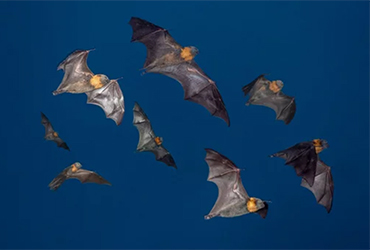
Although they worked with bat viruses that do not infect humans, the scientists provided a powerful model to forecast how dangerous variants could eventually spill over into humans, especially as environmental pressures bring bats closer to human habitats.
In one of the most comprehensive single studies of its type, the researchers collected more than 2,500 guano samples over three years. Bats shed coronaviruses in their guano. Samples were taken from black flying foxes and grey-headed flying foxes at five roost sites across Australia’s eastern seaboard.
Viral testing of the samples showed coronaviruses were most prevalent in juvenile bats between March and July, when they were weaning and approaching maturity. This was consistent across the three-year study. Particularly notable was the high proportion of bats infected with multiple coronaviruses at once.
“We were surprised by that high rate of coinfection among juveniles and subadults,” said Alison Peel, PhD, MSc, BSc(Vet), from the University of Sidney School of Veterinary Science, University of Sidney, who led the study. She added, coinfection was an “important natural precursor to the generation of new strains.”
The six coronaviruses detected in the study were nobecoviruses, a subclass that does not jump to humans. Three of these were new. They were useful to analyze because they pose minimal risk to people but are the evolutionary cousins of sarbecoviruses, the SARS-like viruses that are more prone to spill across to other species. Understanding the evolution of nobecoviruses offers parallel insights into the evolution of more dangerous coronaviruses.
“Coronaviruses tend not to be of major concern to bats,” Dr. Peel said. “But they can behave differently if they spill over to new species.”
These results offer a model for scientists looking to understand and predict the emergence of coronaviruses to assess risk to human disease, according to John-Sebastian Eden, PhD, a study co-author from the Westmead Institute for Medical Research and the university’s Faculty of Medicine and Health.
Dr. Peel said more research is needed to understand why young bats are more susceptible to infection and coinfection.
“It could be the result of newly weaned animals whose immune systems are still developing or the stress faced by teenage bats looking for a mate for the first time,” she said.
The changing environment could also be a factor.
“We know from previous research on other viruses that habitat loss caused by encroaching human populations and food shortages can create stress in bats that weakens immunity and makes them susceptible to infections. It will be important to find out if that’s also the case for coronaviruses.”
The research began in 2020, as the COVID-19 pandemic took hold. It built on earlier research into the spread of Hendra virus, which also originates in bats.