By IDSE News Staff
Dogs may leave more than “pawprints” on our hearts. Scientists at McMaster University and India’s University of Delhi isolated the first live culture of the drug-resistant pathogen Candida auris from the ear canals of stray dogs (J Fungi 2023;9[7]:720; https://doi.org/10.3390/jof9070720).
The finding suggests pets could act as reservoirs for superbugs, potentially transmitting infections to humans, they said.
For the study, the researchers tested skin and ear swab samples from 87 dogs housed in a shelter in Delhi. Of those, 52 were strays already under intensive care for severe lesions due to chronic skin diseases. The remaining 35 dogs were household pets treated for minor gastrointestinal and urinary infections. The subjects’ conditions were not related to the pathogen under study.
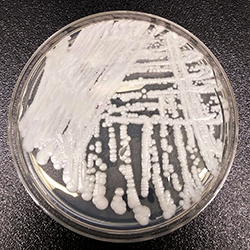
The swabs were cultured for bacteria and fungi using routine diagnostic protocols for skin and ear infections. Researchers found evidence of C. auris within the ear canals of four of the animals with chronic skin infections.
“Even though C. auris was only found in stray dogs in this study, there are many stray dogs in many parts of the world. These dogs could act as transmission vehicles for C. auris to reach other animals and humans,” said lead author Jianping Xu, PhD, MSc, MScAg, a professor in the Department of Biology at McMaster University, in Hamilton, Ontario. He is also an investigator with the university’s Global Nexus School for Pandemic Prevention and Response.
Although fungi are significant pathogens for animals, no live culture of C. auris has been isolated to their knowledge. A DNA analysis pointed to genomic similarities among some of the strains found in the dogs and those found in humans, providing more evidence that the spread of infection to other animals and humans is a risk.

“We need to be vigilant in the surveillance of dogs, other domesticated pets and wild animals in regions where C. auris is endemic,” Dr. Xu said. “While C. auris spreads easily from human to human, the route of transmission among animals or from animals to humans is much less clear, and further investigation is required.”
When humans are infected with C. auris, inanimate objects in the environment are readily contaminated by the shedding of skin scales. Because the yeast was found within the ear canal of the dogs, versus exposed skin, shedding in the immediate environment was reduced, containing the spread of infection, the researchers said.
First reported in Japan in 2009, C. auris quickly spread across the globe. The emerging pathogen can cause persistent and severe infections and widespread outbreaks in hospitals. Antifungal medications often do not work against it, and more than one in three patients with serious invasive infections will die, according to some estimates.
The World Health Organization has declared it one of the world’s four critical priority fungal pathogens.
C. auris has also been discovered on the surface of stored apples, in tidal marshes, in environments with extremely high salinity and, recently, in wastewater, suggesting it can survive in harsh conditions.