By Ethan Covey
Air travel with people who have mpox does not appear to pose a risk for disease transmission, the CDC reported (MMWR Morb Mortal Wkly Rep 2024;73[35]:758-762).
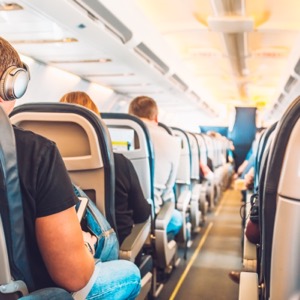
“Hundreds of people have traveled on commercial aircraft while infectious during the ongoing clade II mpox outbreak that began in 2022, prompting the need to assess the risk for mpox transmission on airplanes,” said Francisco Alvarado-Ramy, MD, the chief medical officer of the CDC’s Quarantine and Border Health Services.
The CDC’s analysis, which used data provided by local and state health departments, found that none of the identified potential contacts acquired mpox after exposure on domestic or arriving international airline flights during July 2021 through August 2022.
The analysis confirmed that 113 people (100 passengers and 13 crew members) traveled on 221 flights while they were infectious with mpox. No cases of secondary cases of clade II mpox were identified among 1,046 contacts for whom outcome information was available during the study period.
“The very low risk for transmission associated with air travel also extended to situations where cabin crew members had mpox,” Dr. Alvarado-Ramy said.
Dr. Alvarado-Ramy added that while the CDC report confirms that passengers on U.S. flights are at very low risk of contracting mpox clade II, further research may be helpful to confirm whether the same is true for clade I cases.
“In August 2024, the World Health Organization declared mpox in Central and Eastern Africa a Public Health Emergency of International Concern due to continued increase in cases, geographic spread within Africa and potential to spread beyond Africa; this declaration has prompted questions from the traveling public and airlines as to the risk of mpox in air travel,” he said.
“This prompts CDC also to explore the question of whether these findings regarding air travel pertain to the type of mpox currently spreading in Central and Eastern Africa (clade I). CDC may consider conducting limited aircraft contact investigations for travelers infected with clade I mpox, if cases in recent travelers are identified in the U.S.”
Investigations such as these may help confirm whether the risk for transmission during commercial air travel is the same for clade 1, according to Dr. Alvarado-Ramy.
Dr. Alvarado-Ramy reported no relevant financial disclosures.