

By Ethan Covey
Educators, not children, may be responsible for much of the spread of COVID-19 in schools, according to a CDC report.
The study reinforces the importance of COVID-19 vaccination among teachers and staff at U.S. schools (MMWR Morb Mortal Wkly Rep 2021;70:289-292).
“Initial infections among educators played a substantial role in in-school SARS-CoV-2 transmission and subsequent chains of infection to other educators, students and households,” said Snigdha Vallabhaneni, MD, an epidemiologist with the CDC COVID-19 Response Team. “This finding highlights the importance of preventing infections among educators in particular.”
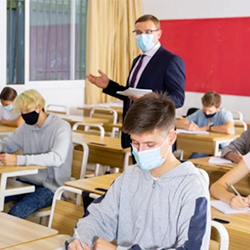
The report focused on SARS-CoV-2 transmission in eight public elementary schools in a single school district, which took place between Dec. 1, 2020 and Jan. 22, 2021, in Georgia. During the study period, an estimated 2,600 students and 700 staff attended in-person classes. The incidence of COVID-19 in Cobb Country, Ga., increased from 194 to 704 cases per 100,000 persons—a rise of nearly 300%.
Nine clusters of cases of COVID-19 were identified, involving 13 educators and 32 students at six of the eight schools. In four of the clusters, the index patient was determined to have been an educator. A student was the index patient in one cluster, and the team of epidemiologists were unable to identify the index patient in four additional clusters. All but one of the clusters involved at least one educator, as well as probable educator-to-student transmission.
“To ensure safer in-person learning during the COVID-19 pandemic, schools should implement multicomponent mitigation strategies, including promotion of COVID-19 precautions outside of school, minimizing in-person adult interactions at school, and ensuring universal and correct mask use and physical distancing among educators and students when in-person interaction is unavoidable,” Vallabhaneni said. Additionally, Vallabhaneni stressed the importance of prompt vaccination of teachers and other school staff, as well as additional study to further clarify how COVID-19 may spread in schools.
“Although not required for reopening schools, COVID-19 vaccination should be considered as an additional mitigation measure to be added when available,” she said. “Understanding SARS-CoV-2 transmission in schools is critical to improving the safety of in-person learning, so studies in multiple contexts will be needed to inform mitigation measures and improve safety.”
School districts and teachers seem to be taking the measure to heart, according to the CDC. Nearly 80% of Pre-K to 12 teachers, school staff and child care workers received at least their first shot of COVID-19 vaccine by the end of March, according to the CDC’s latest estimates and survey data.
“Our push to ensure that teachers, school staff and child care workers were vaccinated during March has paid off and paved the way for safer in-person learning,” said CDC Director Rochelle P. Walensky, MD, MPH. “CDC will build on the success of this program and work with our partners to continue expanding our vaccination efforts, as we work to ensure confidence in COVID-19 vaccines.”
On March 2, Pre-K to 12 teachers, school staff and child care workers became eligible for vaccination and were prioritized within the Federal Retail Pharmacy Program during the month of March. Following this announcement, the number of states where these essential workers were eligible increased by more than 50%. Many jurisdictions made significant efforts, including holding school-specific vaccination events, that contributed to the success of this national endeavor, in addition to the prioritization within the pharmacy program.
More than 2 million teachers, school staff and child care workers were vaccinated through the Federal Retail Pharmacy Program during the month of March. Additionally, 5 million to 6 million were vaccinated through their state programs through the end of March, according to the CDC.