





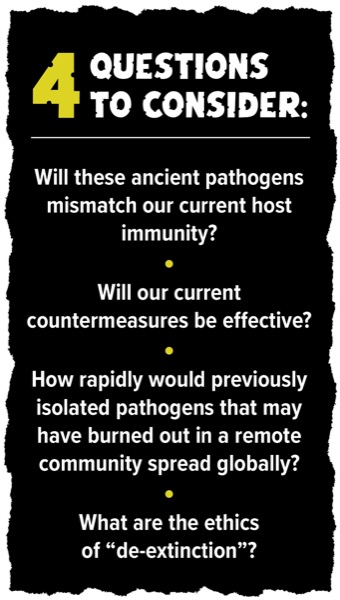
Laboratories freeze organisms to preserve them for long periods. Nature preserves them in the permafrost of the Arctic. As temperatures rise and the permafrost melts, animals and people could be exposed to new organisms—either ones that they have never encountered before or that are quite different from the modern versions of these pathogens.
And make no mistake, the permafrost is melting: In the past 70 years, temperature monitoring in the Western Canadian Arctic has seen an almost 3°C (5.4°F) increase—observed, not projected, explained Emily Jenkins, PhD, DVM, a professor in the Department of Veterinary Microbiology at the University of Saskatchewan, in Saskatoon. Scientists predict 6% to 24% of Alaska’s permafrost will melt by 2100.
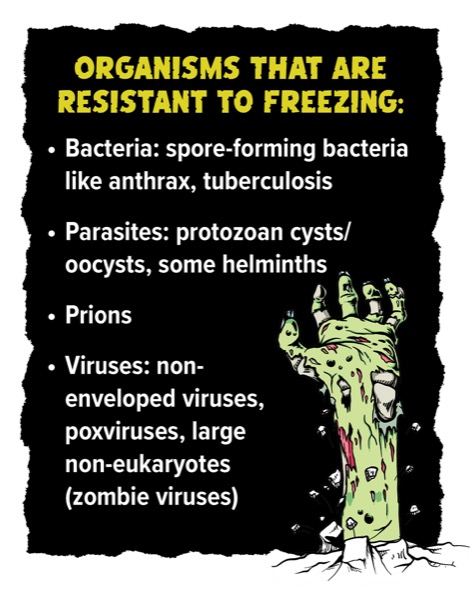
The possibility that infections could arise from exposure to de-frosting organisms does not come from the pages of a 1950s sci-fi comic book but from scientific research. So far, several ancient viruses, including Pithovirus sibericum and Mollivirus sibericum, both isolated from the same 30,000-year-old permafrost sample (Proc Natl Acad Sci U S A 2015;112[38]:E5327-35), as well as roundworms that are 46,000 years old, have been found. In addition, scientists reconstructed the 1918 H1N1 pandemic influenza variant that caused the Spanish flu from bodies that had been interred in the tundra.
What parasites, bacteria, fungi or viruses might lurk in the remains of an extinct prehistoric person or in the carcasses of long-dead animals?
“Nature’s deep freeze of permafrost is certainly something that works well to conserve carcasses of animals, as well as human bodies,” Dr. Jenkins said during IDWeek 2024. “[The permafrost is] cryoprotectant of these pathogens. To know what might be in our future, we need to look to the past at what’s in nature’s deep freeze.”

As the permafrost thaws, cubic tons of organic material “about which we know very little” are being exposed. Although the probability is small that the next pandemic pathogen will spontaneously emerge from the permafrost, “if it does, it could have high consequences,” said Dr. Jenkins, who is also the head of the Zoonotic Parasite Research Unit, graduate chair of the Department of Veterinary Microbiology and co-lead of the USask One Health Signature Area.
In 2019, the Volkswagen Foundation sponsored an event in Hanover, Germany, where experts discussed the likelihood that a pandemic pathogen might emerge from melting permafrost. The consensus was the probability was fairly low, but not zero. Since that conference, several papers documenting spontaneous and intentional reconstruction of pathogens out of permafrost have been published. Although that does not necessarily change the odds for pandemic potential, experts can’t just look to warm climates for potential threats; they need to consider the North, too, according to Jay C. Butler, MD, the deputy director of Infectious Diseases at the CDC. (Dr. Butler spoke in place of Anders Koch, MD, PhD, of the Statens Serum Institut Faculty, in Greenland, who could not attend the meeting.)
In 2016, before the Hanover conference, a heat wave in the Yamal Peninsula in Siberia thawed reindeer carcasses from animals that died 75 years ago. Seventy-two people became ill from anthrax, and one boy died. More than 2,300 reindeer, integral to the life of the ethnic Nenets people of Siberia, also died.
“In the early 20th century, anthrax was devastating to these animals and impacted humans as well,” Dr. Butler said, but a veterinary vaccination program stopped the outbreaks in 1941. Within five years of ending that program, during an exceptionally warm summer, the reindeer thawed, and people and animals were exposed. The Russians reinstituted the vaccination program.
“The North is warming faster than other parts of the world—some [estimate] four times faster in fact,” Dr. Butler said. “And that is impacting the people, the animals, the plants as well as the pathogens in that area.”

Shifting Disease Patterns Also a Problem
Typically, when people think of the occurrence of emerging or reemerging infections, they look to warmer climates. “We’ve got this potential for the emergence of frozen microbes from the thawing permafrost, but I think it is also important to recognize that particularly for people in northern latitudes, there is the likely impact of northward migration of vectors, reservoirs and pathogens,” Dr. Jenkins said.
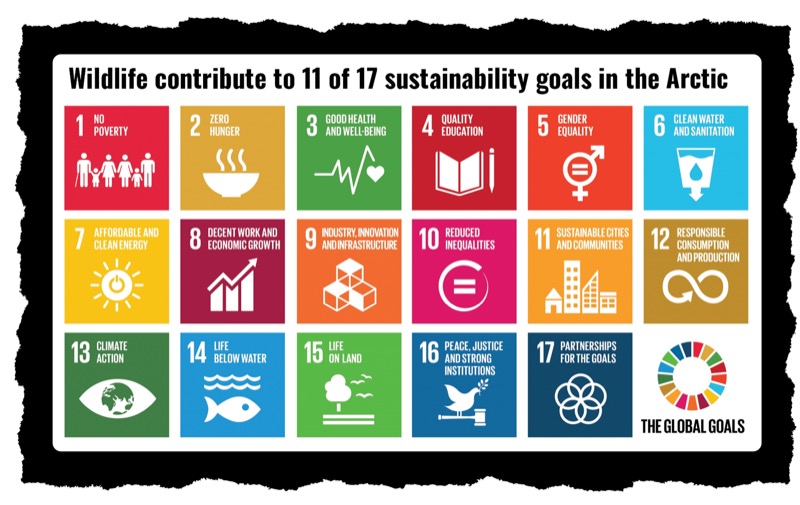
Wildlife will be incredibly important in this scenario because they contribute to 11 of the 17 sustainability goals of the Arctic laid out by the United Nations (see chart on page 19), and they are a source of zoonotic diseases. “There are increasing concerns about the health of wildlife and the stability of wildlife populations on which our Indigenous and residents of the North rely on for healthy, sustainable lifestyles. But we also recognize there are disparities in human health in the Arctic,” Dr. Jenkins explained.
For instance, Toxoplasma gondii, the area of Dr. Jenkins’ research, has a disproportionately high seroprevalence in people in the Arctic, most importantly among women, where it can cause miscarriages and congenital defects if they are infected for the first time during pregnancy. This is a parasite that has few sources on the tundra, a “parasite pollutant” from hosts normally living farther south. Dr. Jenkins and her colleagues showed that foxes, who are scavengers and carnivores, are becoming sentinel species for T. gondii. Their levels of infection are matching the human prevalence across the Arctic, with lower prevalence among foxes in the Western Arctic, where fewer people are infected, and higher in the Eastern Arctic among both.
“We found that foxes that were most likely to be positive for T. gondii had higher exposure and higher consumption of migratory geese and aquatic prey in their diet,” she said. “When a parallel human study was done in the region of the Canadian Arctic that has historically had the highest human seroprevalence, up to 60%, even 80% in some communities, they found epidemiological links to consumption of raw wildlife, especially seals and marine mammals, as well as fish, bivalves, and processing and preparing wild birds, as well as a potential waterborne route,” Dr. Jenkins said.
“We can use direct detection and serosurvey in wildlife to reinforce these findings of human epidemiological studies, which I don’t think I need to tell this room are difficult to rely on and sometimes prone to lapse of memory about diet from days, weeks or even months ago,” Dr. Jenkins said.
Other shifts are also occurring in wildlife patterns. Polar bears in the Western Hudson Bay are seeing warmer, wetter summers and increasingly shrinking sea ice, which is pushing them inward, where they are being exposed to more terrestrial pathogens, including T. gondii.
Mosquitoes are also a problem in the Arctic, and there is a high prevalence of the California serogroup viruses, which affect polar bears, particularly the females who spend more time inland than the males.
“So, not great for the polar bears, but what does this mean for human health?” Dr. Jenkins asked. “Here, polar bears are probably pretty good sentinels of what’s happening in the environment. But does this mean something for people? We have seen sporadic human neuroinvasive disease associated with these California serogroup viruses, most likely Jamestown Canyon virus in the Arctic, but snowshoe hare virus (SSHV) is another possibility.
“And these are exquisitely susceptible to the effects of climate change, both on the development of the mosquito, the activity of the mosquito and how rapidly the virus develops in the mosquito,” she said.
Reservoirs for SSHV are snowshoe hares and rodents, and cervids like caribou serve as reservoirs in the Arctic for Jamestown Canyon virus. “We found a seroprevalence as high as 80% in some of our free-ranging caribou populations. When we looked in Alaska at a captive reindeer herd at the University of Alaska Fairbanks, we found that of the yearlings that were exposed in their first summer to mosquitoes, 90% of them seroconverted,” she said.
Ticks are another problem, according to Jan C. Semenza, PhD, MPH, MS, the project manager in the Department of Epidemiology and Global Health at the University of UmeÅ, in Sweden, as warmer weather allows them to move farther north bringing their zoonotic diseases with them.
The incidence of tick-borne encephalitis infections have increased in places like Sweden, he said. Modeling has projected a 62% to 118% increase in tick-borne encephalitis cases depending on how warm the temperatures become.
More severe storms globally, including in the Arctic, will increase the number of waterborne diseases. Standing water provides a breeding ground for mosquitoes, as well as a transmission vehicle for diseases like leptospirosis. If sewers or septic systems are overrun by storms, it could be a platform for exposure to fecal coliform bacteria, he said.
Prepping for Surprises From the Arctic
To prevent these forms of exposure, “animal health, environmental health and human health need to be monitored in a comprehensive way,” Dr. Semenza said.
Early-warning systems, such as wastewater surveillance, could be instrumental in detecting these problems. A climate-resilient water infrastructure also can be useful. Sweden, which has experienced a number of Cryptosporidium outbreaks, uses UV irradiation because chlorine does not kill off the oocytes.
“But One Health isn’t just about identifying the next big risk or problem; it’s also about mitigation and what we can do about it. And there are many more strategies that we have in our toolbox than we had before,” Dr. Jenkins said. “But we need to have all hands on deck for these One Health teams.”
The first line of defense are front-line care physicians and veterinarians, as well as biologists, soil scientists, urban planners, social scientists, even museum workers who are often excavating remains.
“Indigenous knowledge keepers are absolutely invaluable in recognizing strange patterns in what’s happening on their land with their wildlife,” Dr. Jenkins said.
Citizen scientists can be useful by identifying unusual ticks or other vectors when they move into an area, according to Dr. Semenza.
The important issue is recognizing the threat as early as possible, they all said. “We really are not good at predicting where the next pandemic is going to come from. We do as much as we can to be prepared, but oftentimes nature has a way of surprising us,” Dr. Butler said.
“While I think we’re appropriately looking into the tropics for the next pandemic, it’s important to not forget about the Arctic because the population is very sparsely spread. We have large populations of animals, and it is an area that is warming faster than anywhere else in the world.
“Perhaps what scares me more than the melting permafrost is the lack of data from the far north. So that could definitely be one of those things that will surprise us. This lack of data is something that we need to address—those of us who work in the circumpolar areas, because the lack of data here be dragons.”
The sources reported no relevant financial disclosures. Dr. Butler reiterated that the views expressed are his own, and not that of the CDC.

This article is from the February 2025 print issue.