Originally published by our sister publication Pain Medicine News
By Jordan Davidson
Patients with hepatitis C virus had profound increases in cure rates when telemedicine appointments with hepatologists were integrated into opioid treatment programs in a recent study.
Although direct-acting antivirals (DAAs) are highly efficacious at eliminating HCV, access remains a considerable challenge for people with opioid use disorder for many reasons, including perceived stigma when seeking healthcare.
“But the results ... show that when you make things easy for patients, they’ll participate. If you can have the doctor see them right now, you can greatly help people complete treatment,” said lead researcher Andrew Talal, MD, MPH, a hepatologist at the Jacobs School of Medicine and Biomedical Sciences at the State University of New York, University at Buffalo.
In the study, Talal and his co-investigators recruited more than 600 HCV-seropositive patients at 12 different opioid treatment programs (OTPs) across New York state over four nine-month periods (JAMA 2024;331[16]:1369-1378). Nearly half (49.2%) of patients identified as non-white and a majority (61.3%) were male.
The 290 patients in the intervention arm had a case manager at the OTP facilitate a telemedicine appointment with a hepatitis specialist. The telemedicine clinician evaluated the participant and their bloodwork and ordered DAAs that were delivered to the OTP and dispensed along with methadone. The patients were provided with take-home DAA doses for days when they did not appear in person at the OTP.
The 312 patients in the referral arm followed the standard of care, in which patients received a referral to see an off-site hepatitis specialist, such as a hepatologist, infectious diseases specialist or a primary care physician. Case managers then followed up monthly with participants and the referring clinician to gauge whether treatment had been initiated, followed through and to assess the outcomes.
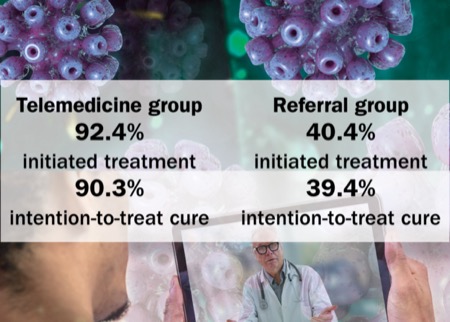
Dr. Talal and his co-investigators found that patients were nearly three times more likely to be cured when an OTP facilitated a telemedicine appointment with a hepatologist and ensured access to DAAs compared with the standard of care. In the telemedicine group, 92.4% of patients initiated treatment, and the intention-to-treat cure percentage was 90.3%; in the latter group, 40.4% initiated treatment and the intention-to-treat cure percentage was 39.4%, which Talal said “was actually slightly higher than what we expected.”
In addition, the intervention aided the goals of the OTP, as patients cured of HCV were far less likely to have a drug relapse or HCV reinfection during two years of follow-up.
“When you have a receptive audience and you can set up telehealth right away, it becomes frictionless and very easy to not only initiate treatment but to follow through with it,” Dr. Talal said. “They’re already at the OTP facility so they don’t need to worry about stigma, as they might encounter in conventional healthcare settings, finding time away from work or arranging child care. All of the typical reasons why people might avoid care can be minimized, and people follow through with care.”
He noted that while all the subgroup analyses favored intervention with telemedicine by a wide margin, a profound effect was seen in Hispanic women—two of 26 participants in the referral group were cured compared with 26 of 28 in the telemedicine arm. Similarly, 97.8% of the rural participants in the telemedicine arm were cured compared with 28.9% in the referral group.
Telemedicine Can ‘Drastically’ Improve Outcomes
“This study shows how vital it is to provide hepatitis C screenings and treatment at the point of care, and how effective a simple intervention can be in drastically improving outcomes,” said Anurag Maheshwari, MD, a liver disease specialist at the Center for Liver and Hepatobiliary Diseases at Mercy Medical Center, in Baltimore.
“Right now, we have far fewer treaters of HCV than people with HCV, but the people who have it will never come to my office,” added Dr. Maheshwari, who was not involved with the study. “This study shows how we can bring healthcare to the patients through the addiction centers.”
Lynn R. Webster, MD, a senior fellow at the Center for U.S. Policy and a pain medicine expert, in Salt Lake City, who was not involved in the study, agreed. “This finding suggests that OTPs could use these results to justify and expand the use of telemedicine to improve healthcare access and outcomes for patients in recovery,” he said.
Dr. Maheshwari noted that “while this could easily be scaled up,” it will be important to consider ways to incentivize and remunerate addiction centers for doing this work so they will want to incorporate such programs.
Dr. Maheshwari reported no relevant financial disclosures. Dr. Talal reported financial relationships with BMS, Genfit, Gilead, Intercept, Lilly and Merck.