By Karen Blum
Patients with multidrug-resistant HIV make up a small but still challenging part of the population living with HIV. With careful monitoring and new drugs in the pipeline, providers can continue to help their patients.
“It’s really great that we have a relatively low number of patients with this issue,” said Milena Murray, PharmD, MSc, BCIDP, AAHIVP, an associate professor of pharmacy practice at Midwestern University-Chicago College of Pharmacy, and an HIV/infectious disease clinical pharmacist with Northwestern Memorial Hospital. “Patients can have one or two mutations and still have plenty of options at this point.”
About 3% to 7% of the HIV population are considered multidrug-resistant (MDR) and need additional new agents, said Michael Kozal, MD, a professor of medicine at the Yale School of Medicine, in New Haven, Conn., and the chief of staff for the VA Connecticut Healthcare System. He has studied MDR HIV since 1991.
People can develop resistance to multiple drugs for several reasons, said Dr. Kozal and Jonathan Appelbaum, MD, FACP, AAHIVS, a professor and the chair of the Department of Clinical Sciences at Florida State University College of Medicine, in Tallahassee.
Children who acquire HIV perinatally often have problems adhering to medication, and can burn through several drugs by the time they reach adolescence and young adulthood. Some patients are less adherent to medication because they’re in and out of the criminal justice system, have substance use issues or for other reasons, and develop viral mutations that render the drugs ineffective. Additionally, some patients experience drug toxicities or can’t tolerate some of the existing drug classes, or are long-term survivors initially diagnosed in the late 1980s/early 1990s who have gone through a myriad of drugs over time.
“We have had a number of great agents over six different drug classes, but some people develop drug resistance,” Dr. Kozal said. “It sounds like a lot—six classes—but as patients have reactions, it limits the drugs they can take, and some patients are infected with drug-resistant virus. There is a need for new agents that have different mechanisms of action.”
Until the past couple of years, there were a limited number of targets on the virus that could be hit by available medications, said Dr. Appelbaum. Recently, several new targets have emerged, including drugs designed to inhibit the maturation of the virus inside cells or prevent the entry of HIV into immune system T cells.
“The good thing about these new drugs is they don’t show cross-resistance to the existing drugs, because their mechanisms of action are different,” he said. “If you’re resistant to the older drugs, you are not automatically resistant to these [new ones].”
One of the newer medications is an attachment inhibitor, ibalizumab-uiyk (Trogarzo, Theratechnologies), approved by the FDA in 2018. The drug, a monoclonal antibody that binds to the surface of immune cells, blocks the steps required for viral entry into cells. “This is a great drug that has worked well,” Dr. Appelbaum said.
The approval was based on safety and efficacy data from a clinical trial in 40 heavily treatment-experienced patients with MDR HIV, who continued to have high viral loads despite being on antiretroviral treatment (ART). Many of the participants had been treated with 10 or more antiretroviral drugs. Most of the patients experienced a significant decrease in their HIV RNA levels one week after IV ibalizumab-uiyk was added to their failing ART regimens. After 24 weeks of use of ibalizumab-uiyk plus other antiretroviral drugs, 43% of the trial’s participants achieved viral suppression.
The clinical trial focused on the small patient population who had limited treatment options and demonstrated the benefit of ibalizumab-uiyk in reducing the viral load.
Ibalizumab-uiyk significantly reduced the viral load within seven days after the first dose of functional monotherapy and maintained the treatment response when combined with an optimized background regimen that included at least one other active ART for up to 24 weeks of treatment.
The medication is delivered by IV once weekly instead of daily, but because it is given intravenously, it is not typically used early in HIV treatment, according to Dr. Appelbaum.
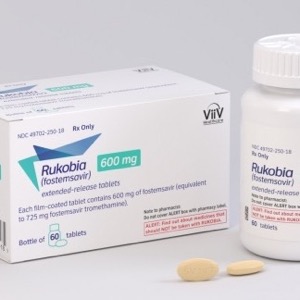
Fostemsavir (Rukobia, ViiV Healthcare), which was just approved, was developed specifically for patients with MDR HIV and works by a novel mechanism of action, said Dr. Kozal, the lead author on a recent article describing phase 3 trial results (N Engl J Med 2020;382[13]:1232-1243).
Fostemsavir is a prodrug whose active metabolite, temsavir, is an attachment inhibitor that prevents viral entry into host immune cells by binding to a glycoprotein on the surface of the virus. In the ongoing BRIGHTE trial in 23 countries, 371 patients with MDR HIV-1 infection have been given fostemsavir along with their failing HIV regimen. After 48 weeks of therapy, 54% of randomized and 38% of nonrandomized patients who took the drug had undetectable viral RNA levels. The most common side effects included diarrhea, nausea and upper respiratory tract infections. ViiV Healthcare submitted a New Drug
Application to the FDA last December for the medication, which has been granted fast track and breakthrough therapy designations.
“The data were very promising in that the viral load stayed nondetectable in a large number of patients out to week 48,” Dr. Kozal said. “There’s no cross-resistance to other classes, so we think it’s going to be helpful for people who have exhausted other drug classes or can’t take other drug classes because [of intolerance].”
Management
Current management of patients still comes down to individual resistance profiles, Dr. Murray said. Protease inhibitors are good options for some patients with drug resistance. Maraviroc can be helpful but requires a tropism assay. Enfuvirtide (Fuzeon, Genentech) is an injectable that may cause painful injection site reactions and usually is used as a last resort. At times, adding an integrase inhibitor to the regimen will be enough if there are no mutations to this class.
“Sometimes we need to have patients on four to five medications, but that regimen is able to get them to an undetectable viral load,” she said, whereas other times medications are not enough to get to undetectable but can keep the viral load at a lower point. Ibalizumab-uitk can be a good option for patients who are extensively drug-resistant, she added.
“One of the caveats of HIV treatment is you never want to add on or substitute just one drug if patients have resistance to multiple drugs,” Dr. Appelbaum noted. “You want to have two, and ideally three, active medications.”
When monitoring patients, Dr. Murray said, always check the viral load. “If patients are undetectable, that’s the best-case scenario,” she said. “But if we can’t get them to undetectable, we want to make sure their viral load isn’t continuing to increase.”
In addition, monitor CD4 counts to make sure that’s not decreasing. Check for any signs or symptoms of opportunistic infections and be certain any comorbid conditions are being managed. Follow all guideline recommendations for screenings.