





People given injectable long-acting cabotegravir (CAB-LA; Apretude, ViiV Healthcare) as pre-exposure prophylaxis (PrEP) for HIV have higher levels of medication adherence than oral PrEP users.
However, real-world data about adherence to PrEP with CAB-LA presented at CROI 2024, held in Denver, suggest that although adherence rates are good, some patients miss injection appointments. Laurence Brunet, PhD, the senior director of epidemiology at Epividian in Raleigh, N.C., who presented these results at a poster session (poster 1109), suggested that oral bridging might be useful for them to help bridge the gap and enable them to stay on
“[Most] people taking CAB-LA PrEP were able to come into the clinic to receive their injections on time. And over the study period, only one person tested positive for HIV, although determining whether the patient became infected during oral PrEP or during CAB-LA PrEP is unclear because the HIV testing was too infrequent,” Dr. Brunet said.
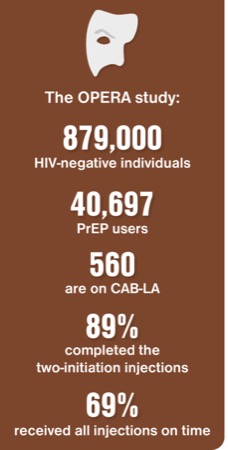
The study used data collected between December 2021 and March 2023, from the OPERA (Observational Pharmaco-Epidemiology Research & Analysis) study. OPERA includes the health records of 879,000 HIV-negative individuals, including 40,697 PrEP users across 101 clinics in 23 states and U.S. territories. Of the 560 HIV-negative people who received more than one injection of CAB-LA PrEP through routine clinical care in the study cohort, 89% completed the two-initiation injections.

Among the complete initiators, 69% adhered to the injection schedule and received all injections on time. It was noted that 11% of the complete initiators missed an injection. However, missing an injection does not necessarily indicate a gap in PrEP therapy, since oral bridging therapy may have been used to help keep patients on their therapeutic schedule, according to the researchers. Furthermore, “information on use of oral bridging or oral PrEP on demand is poorly documented in electronic health records, and gaps in PrEP coverage may be overestimated in this study,” Dr. Brunet said.
The researchers analyzed covariates—age, race, history of PrEP use, geographic region, sexually transmitted infections within 12 months of initiating CAB-LA therapy, and relationship status—but none were statistically significant or able to help explain what factors might be associated with missing injection doses.
However, the fragmentation of the U.S. healthcare system could be an important factor.
“[The] fragmented healthcare system and insurance issues in the U.S. has not allowed adequate access to and uptake of long-acting PrEP by 2024,” said Monica Gandhi, MD, MPH, the director of the University of California, San Fransisco’s Bay Area Center for AIDS Research, who was not involved with the study.
She highlighted the fact that out of 40,697 individuals on PrEP in the study, only 560 (or 1.4%) are on CAB-LA. This is true even though CAB-LA has had a PrEP indication since December 2021, and “long-acting ART [antiretroviral therapy] or PrEP are great options for those with homelessness, mental health concerns or substance use because the long-acting regimen can obviate the need for daily pill-taking.”
Dr. Brunet agreed with this analysis and noted, “Providers should be mindful of individuals who come in less regularly for their injection and counsel these individuals on the importance of oral bridging when delays cannot be avoided.”
A limitation of the study is the data were based on health records; therefore, the researchers were not always aware of changes in a person’s risk for HIV and whether that motivated them to alter their adherence to PrEP. An analysis of HIV testing practices, which could help address this limitation, will be presented at this year’s 25th annual AIDS Conference in July, in Munich.
On the horizon, Dr. Brunet reported that her research team is updating this study with a longer inclusion period and longer follow-up. Additionally, the updated study will have a larger sample size and administer a greater number of injections, which might help answer some of the remaining questions.
Dr. Brunet is employed by Epividian, which has had research funded by AIDS Healthcare Foundation, EMD Serono, Gilead Sciences, Janssen Scientific Affairs, Merck, Theratechnologies and ViiV Healthcare. This study was supported by ViiV Healthcare. Dr. Gandhi reported no relevant financial disclosures.



This article is from the June 2024 print issue.